
The Crypt is a terrifying collection of classic horror movies, from nightmares and teenage terrors to spiritual visitations, buckets of gore, and frivolous frights.
Jump Straight to a Film
Explore more: Horror
FROZEN (2010)
By Neil Baker
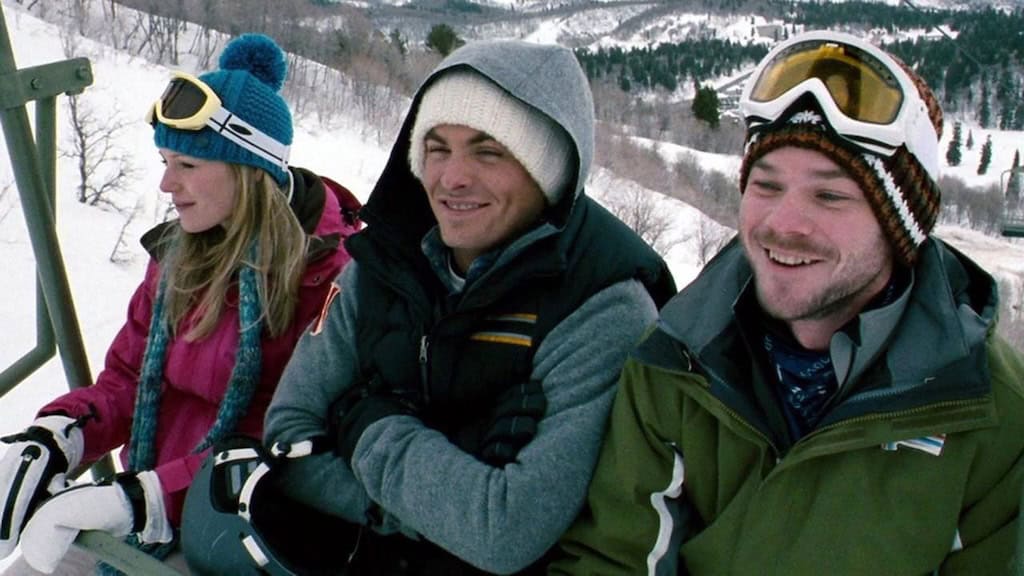
It was supposed to be a romantic ski trip in the mountains, but right from the outset, Parker O’Neil’s (Emma Bell) romantic break is disrupted by having her boyfriend’s (Kevin Zeger’s) best mate (Shawn Ashmore) in tow. Still, there’s time for romance when they get back home, right? Not if a didgy ski-lift and pack of ravenous wolves have anything to say about it!
If you hate ski lifts and think they are the most dangerous contraptions ever made, or have a deep-seated fear of wolves, Frozen may be a step too far in your weekend viewing choices! Adam Green’s Frozen is one of the most nerve-shredding films released during 2010, and a movie where you find yourself shrieking at the screen in horror as you watch three twenty-somethings fight for their lives on a stalled ski-lift as the night draws in, and love and friendship become a game of survival. Sometimes, no matter how chivalrous you are, nature and mechanics have other plans!
Frozen was largely overlooked upon its release, yet Green’s movie is a tour de force in terror that will leave you questioning whether to ever get on a ski lift again!
SWALLOWED (2022)
By Neil Baker
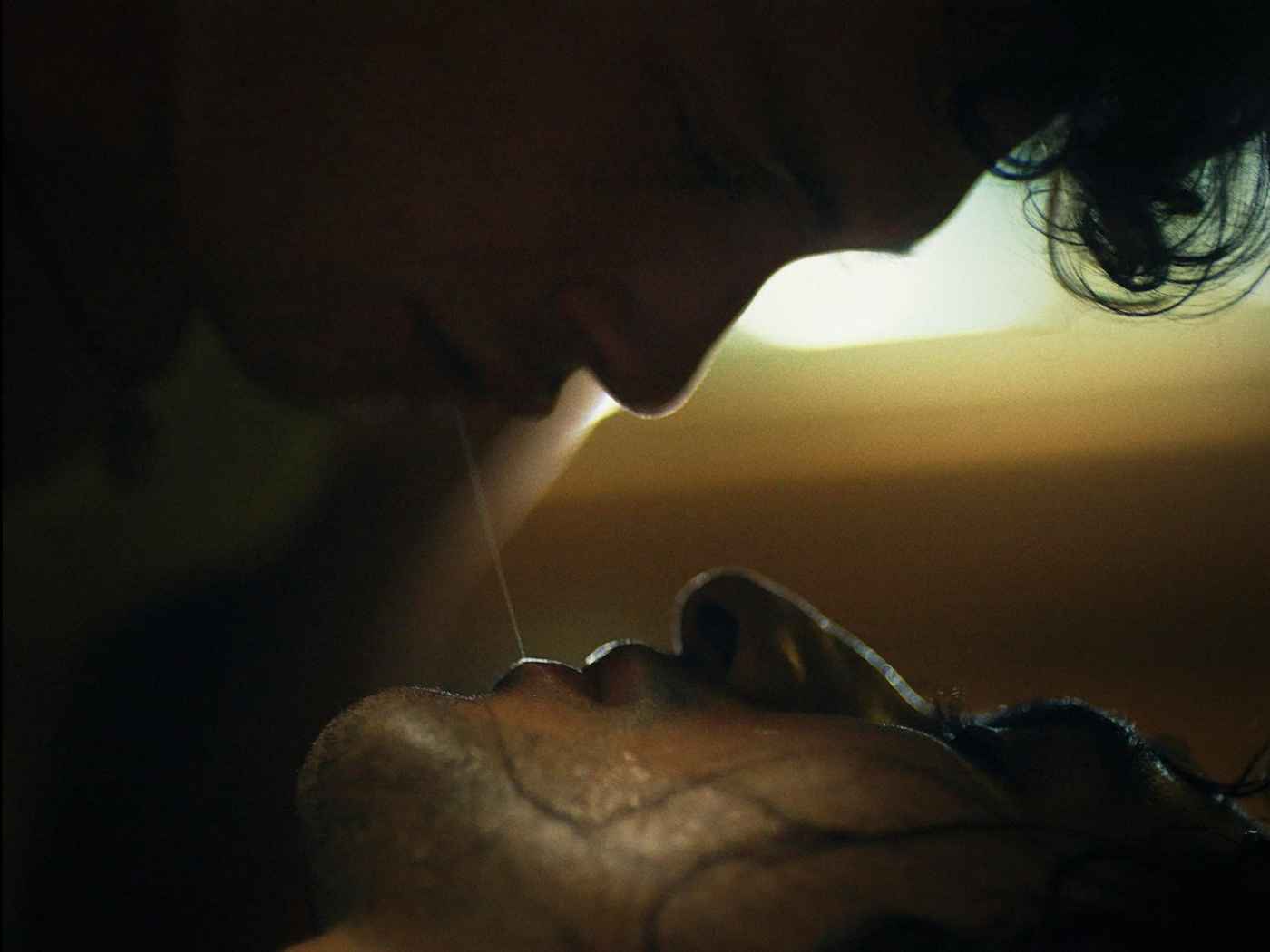
Shawn Mendes lookalike, Benjamin (Cooper Koch) and Dom (Jose Colon) are best friends, but the time has come for them to part, with Benjamin preparing to leave their small town for the bright lights of Los Angeles. As they enjoy one last night clubbing together, Benjamin’s decision is final, despite a deep, unspoken love for his best mate. But maybe it’s better to run than face rejection from the boy he has secretly loved for years.
Meanwhile, Dom hides his concerns for Ben despite a fear that he won’t be able to protect himself in the big city. But even more pressing is the matter of his unspoken love for his friend, a love that has burned with increasing ferocity over recent years. As the night progresses, both boys suppress their true feelings for one another, instead enjoying a final night together before the sun rises and they part ways.
But the night is about to take a deadly turn as Dom announces he wants to give Ben some money to help in Los Angeles if things go wrong. There’s just one catch: Dom will need to courier some drugs over the border. For Dom, his friend is worth the risk until he finds out from the dealer (Jena Malone) that the cling film-wrapped bundles of drugs are to be swallowed before transit. Even more disturbing, Dom is given clear instructions on how to care for the packets when they leave his body. What is this strange drug? Ben wants to run a mile, but it’s too late as Dom swallows each package at gunpoint. Ben may be willing to use his body for his financial security and escape, but Dom is ready to use his to support the boy he secretly loves.
A NIGHTMARE ON ELM STREET (1984)

By Neil Baker
Have you ever had a nightmare so vivid and real that it left a lasting impression? Most of us, at some point in our lives, have had that one nightmare that stays with us forever, haunting us in our waking moments as much as it did in our bed.
In part, Wes Craven based his mid-eighties horror on a true story he had read many years before. It was the story of a family who had escaped the Killing Fields in Cambodia for the United States, but no matter the distance travelled, their young son continued to have disturbing, uncontrollable nightmares. The boy tried to stay awake for days, but sleep was unavoidable in the end. As he drifted into a deep sleep, his screams suddenly awoke his parents, and the room fell silent. The boy was dead, and he had died in the middle of the nightmare that haunted his every waking moment.
It’s easy to see why and how this story helped give birth to Craven’s masterpiece. But while this story sat at the heart of teenage Nancy and her friend’s blood-soaked nightmare, Craven’s movie also had another trick up its sleeve.
Craven’s Nightmare on Elm Street wasn’t just about the fear of never waking up; it was a tale of the secrets and lies that haunt a picture-perfect street of white picket fences and manicured lawns. Secrets that are never fully buried or burnt, no matter how much residents may like to think they are. Freddy Krueger was a child rapist, a paedophile who stalked his young prey before the parents of Elm Street came together to kill him and burn his body; he was every parent’s worst nightmare, and now he has returned to seek his revenge on the mob who murdered him.
Craven’s movie cleverly laces teenage fears with adult (non-supernatural) fears of protecting our children at any cost in a film that speaks to multiple generations and continues to haunt our every waking moment forty-one years on.
A NIGHTMARE ON ELM STREET 3: THE DREAM WARRIORS (1987)
By Neil Baker
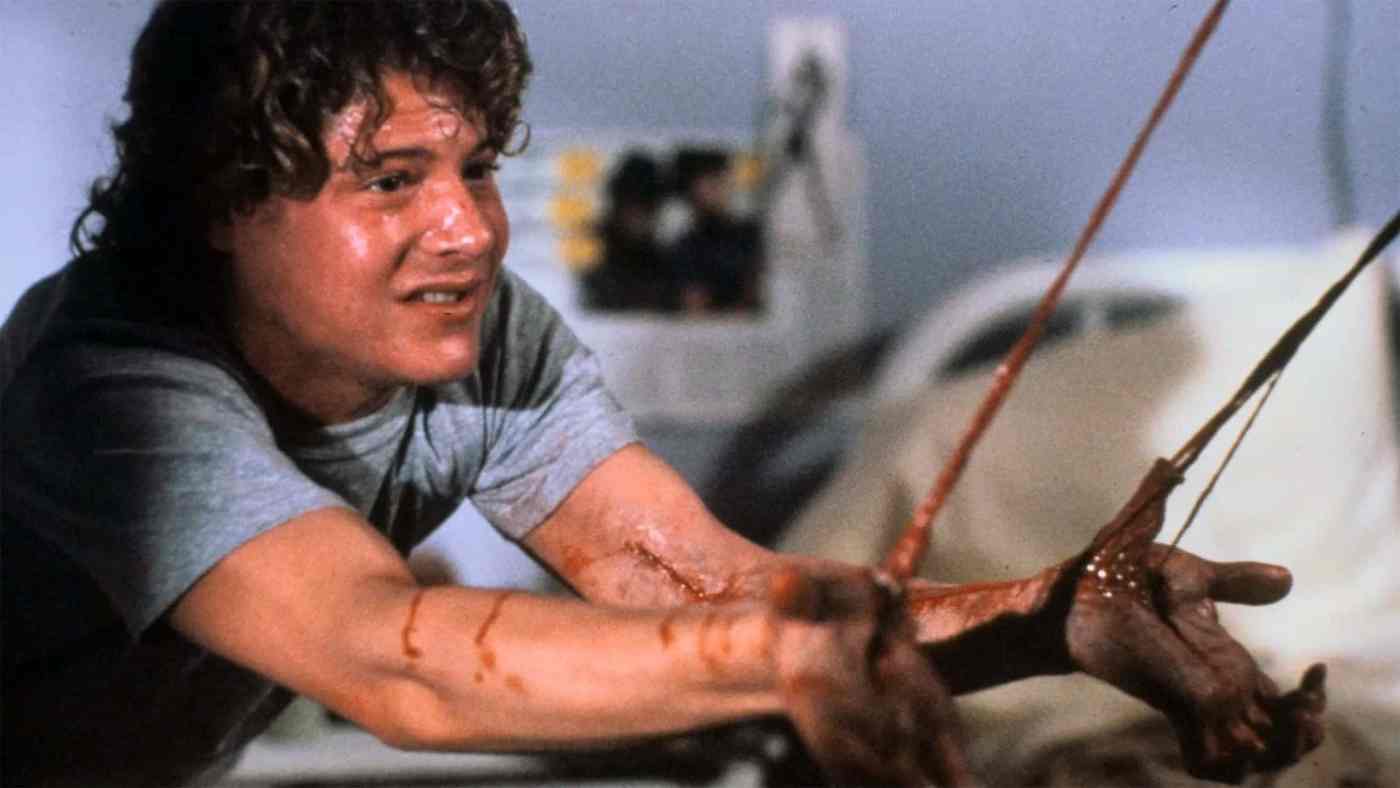
Directed by Chuck Russell, Freddy’s third outing, Dream Warriors, would attempt to reverse much of the criticism levelled at Freddy’s Revenge on and after its release by handing the story-writing duties back to Wes Craven for what was initially planned to be the final outing for Krueger.
Craven and his fellow writer Bruce Wagner would jettison the single heroine or hero and introduce a group of sleep-deprived fighters as co-leads in the battle against Krueger. However, they would reintroduce a series of familiar faces from the first outing to ensure continuity, while allowing cameos by Zsa Zsa Gabor and Dick Cavett to boost the humour.
Equally, Dream Warriors would capitalise on the popularity of role-playing games in teen culture, creating a fantasy-laced horror that firmly placed Freddy at the forefront of a changing technological era in filmmaking. The result is a movie that laces sharp humour with teenage fantasy and unforgettable gore.
The Crypt – the home of classic horror movies
THE TERRIFIER TRILOGY (2016 – PRESENT)
By Neil Baker
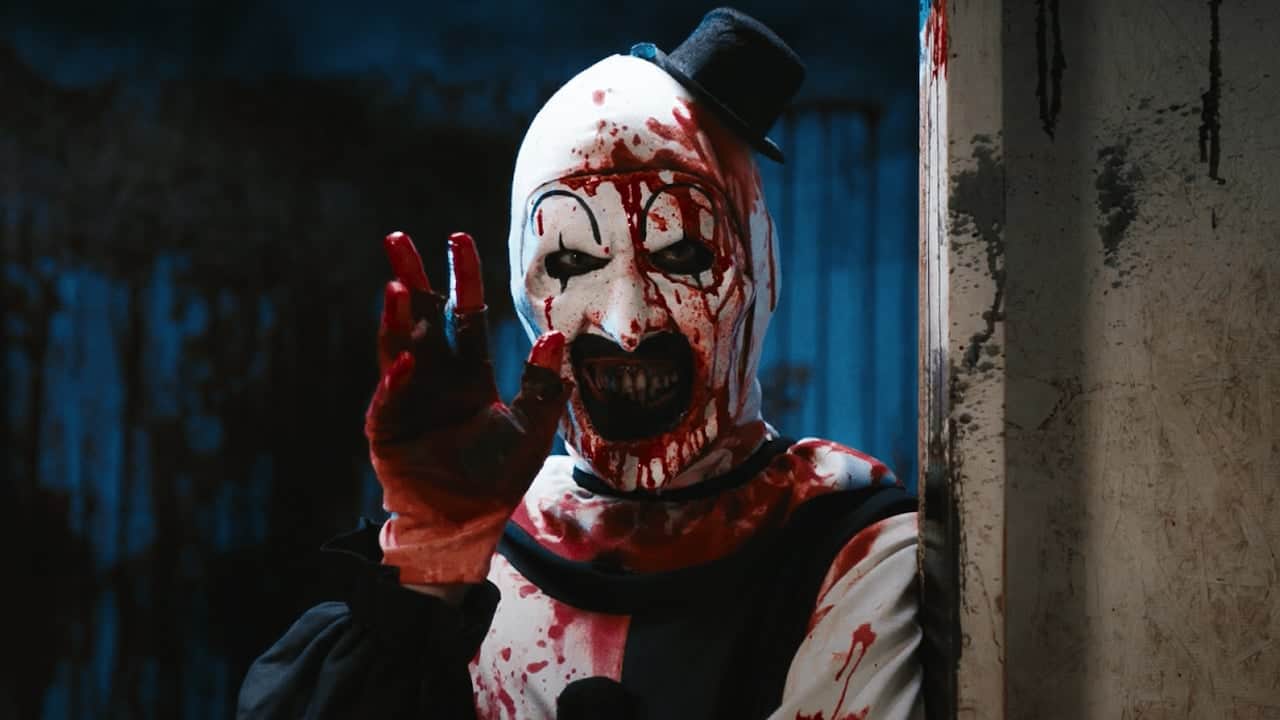
Where do I start when exploring the gore and horror of Damien Leone’s Terrifier? I guess the best place is with the genius of Art the Clown. Devilishly brilliant horror villains are rare; the 70s gave us Leather Face, The Xenomorph and Damien, while the 80s gave us Michael Myers, Chucky, and Freddy Krueger, to name just a few. However, when exploring modern-day monsters who lodge in our collective memories and give us sleepless nights, the list is far shorter, but at the top of that list is Art, played by the brilliant David Howard Thornton.
Art’s bloodlust is already legendary, and his place in horror movie history has been cemented for decades to come in just two bloodcurdling movies. Like his name would suggest, this silent killer clown sees each gore-laden murder he enacts as ‘art’ and ‘entertainment’, joyously carving, castrating, gutting and skinning his victims alive in two movies that push the boundaries of gore on the screen to their very limit. Even those of us with a cast-iron stomach are left feeling queasy after just ten minutes in Art’s presence!
Damien Leone’s Terrifier (2016) introduced us to Art and his bloody world of clown horns, knives and saws in an opening movie that mixed elements of the classic ‘80s slasher movie with a far more ruthless and sharp modern edge, where the audience was never entirely sure whether anyone would walk away from Art in one piece (literally). But it was his sequel in 2022 that genuinely brought this killer clown and the universe surrounding his bag of deadly tricks to life as he expanded Art’s story, further pushed the boundaries of horror and introduced us to Art’s Nancy Thompson, ‘Sienna’ (Lauren LaVera) and her younger brother Jonathan (Elliott Fullam).
Terrifier 2 wasn’t just a huge step up from Terrifier in narrative complexity and world-building, but also a truly disgusting, stomach-churning slice of horror that still lives in my memory, daring me to endure a repeat viewing.
However, if, like me, you thought Terrifier 2 pushed the boundaries of gore to the limit, the dial was about to be turned up even further in the third instalment. Let’s just say a vomit bag may be essential alongside your combo meal. Not only did the gala screening in London see 11 people walk out and one succumb to the need to vomit, but France’s film classification committee have given it an under-18s ban, the first of its kind in almost 20 years!
Can Leone take it even further in a fourth outing? I guess we will find out soon!
POLTERGEIST (1982)
By Neil Baker
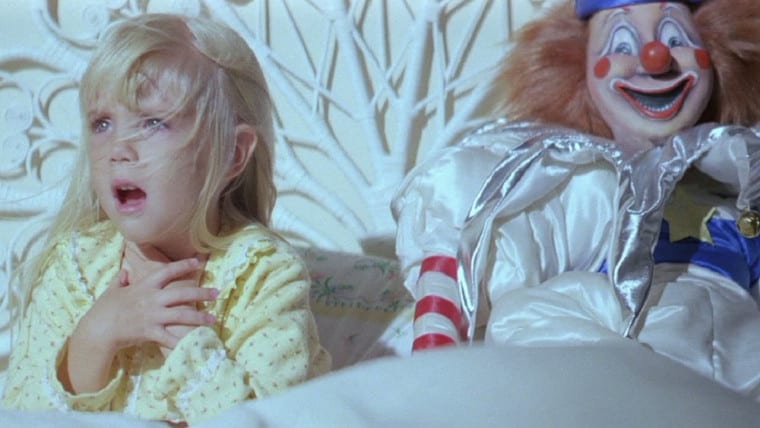
In 1982, Steven Spielberg and Tobe Hooper combined their talents for Poltergeist, with Hooper’s eye for classic horror dovetailing with Spielberg’s fierce imagination and technical prowess.
The result was a scary, fun, and unexpected rollercoaster ride full of our deepest childhood and adult fears. In Hooper and Spielberg’s world, toys come alive, a paranormal beast hides in the closet, a terrifying tree invades the safety of a child’s bedroom, and a child is taken from the safety of a loving family home.
There are echoes of Close Encounters of the Third Kind, The Twilight Zone and The Changeling (also based on the alleged Cheesman Park haunting) in Poltergeist. However, while many argue that Poltergeist’s true terror lies in the classic family-invasion trope, at its heart, Poltergeist is a maternal horror. It’s JoBeth Williams who sits centre stage as she fights to bring her child home from a spiritual abduction, with the film’s final scenes akin to childbirth as a middle-class American mother fights an unseen force to protect her child at any cost.
Poltergeist gave birth to a host of supernatural horrors, from The Conjuring to Paranormal Activity and Insidious. But no film since has captured the atmosphere, the fun, or the maternal terror at the heart of Hooper and Spielberg’s film, making Poltergeist one of the most influential horror movies ever made.
Explore More
The Crypt – the home of classic horror movies
CHILDREN OF THE CORN (1984)

By Neil Baker
On its release in 1984, few would have predicted that Fritz Kiersch’s low-budget adaptation of a short story by Stephen King, later published in King’s 1978 collection Night Shift, would spawn a franchise of killer-kids movies.
Gatlin is your typical midwestern American corn town until its kids mysteriously decide to rid the place of all adults. But what could have caused this pint-sized rebellion of knives, scythes and ropes? When a young couple, Vicky and Burt, stumble upon the seemingly deserted town, they soon find a circus of dungaree-wearing killer kids led by the stony-faced Isaac, a charismatic child preacher who feeds a sinister force lurking in the cornfields.
King’s short story explores the destructive power of religious fanaticism over children and the ease with which they can be manipulated, while lacing it with the supernatural influence of a beast or entity hiding in plain sight. While Kiersch’s film would veer from King’s story in several key areas, most notably the conclusion, it retains the themes of ritual, cult control, and religious fundamentalism from the short story.
Like Who Can Kill a Child, Children of the Corn never seeks to answer all the questions it raises as it explores the interface between innocence and evil. Whether that evil is supernatural or religious is ultimately a matter of personal interpretation.
CHRISTINE (1983)
By Neil Baker
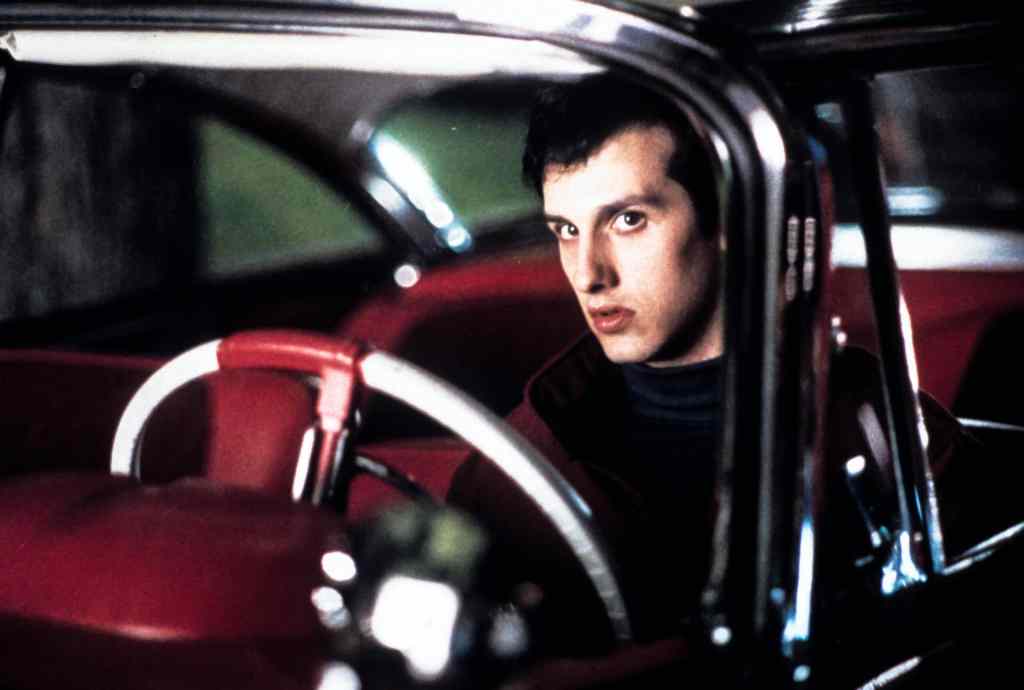
The story of a boy and his first car is as American as apple pie and cream, with many movies exploring the car as an extension of a boy’s emerging manhood. In most cases, the vehicle merely represents a boy’s need to belong in a confusing world of masculine stereotypes. In Christine, Stephen King twists this rite of passage into something far more horrific as a killer car and a damaged boy come together in the headlights of an unbreakable and deadly bond. The film rights to Christine were snapped up before the novel had even hit bookshop shelves.
John Carpenter understood Christine was the star of the show, her headlights beaming as she revved up for murder. But while Christine may steer each death, the confused and isolated Arnie (Keith Gordon) sits at the wheel. Here, Christine and her twisted mechanical love consume Arnie’s life and turn him into the ultimate killer kid.
Often copied but never bettered, Carpenter’s Christine is nothing short of an absolute blast, its polished physical effects still gleaming nearly forty years after its release. So buckle up for one hell of a ride because Christine is one film that doesn’t run out of gas halfway through.
The Crypt – the home of classic horror movies
CARRIE (1976)

By Neil Baker
First published in 1973, Carrie White could be argued to be the character who made Stephen King. Coming just three years after the book’s massive success, Brian De Palma’s adaptation of Carrie is not only faithful to King’s material but also one of the greatest horrors ever made. However, like much of King’s work, supernatural terror is not the core of the horror; puberty, bullying, abuse and religious extremism are.
King’s story and De Palma’s movie are a journey into isolation, family trauma, and teenage anxiety—a coming-of-age story with a horrific conclusion. De Palma keeps the camera on Carrie White throughout, allowing the audience to build empathy and understanding before the bloodshed of the final act.
Even as the bodies pile up at the Prom from hell, Carrie remains the victim of the piece. Often copied but never bettered, Carrie is a journey into the pain and torment of a girl who simply seeks understanding and kindness in a cold, cruel world.
Explore More
THE PIT (1981)

By Neil Baker
Lew Lehman’s strange Canadian cult movie, The Pit, is long forgotten in the celluloid mists of time, its story a peculiar mix of horror, fantasy, and obsession.
Released in 1981, The Pit centres on a disturbed, isolated, obsessive young boy named Jamie, a pit home to some strange creatures called Trogs, a babysitter whom Jamie would like to ‘get to know’, and a demon teddy bear. To say Jamie’s a screwed-up kid would be an understatement. But he is also frequently bullied and misunderstood, meaning there’s a good dose of empathy for this psychotic munchkin even when he starts feeding the Trogs, the humans who have upset him.
Meanwhile, away from the deep dark hole in the woods, Jamie has the hots for his babysitter and does everything he can to orchestrate some form of romance, even if it means the odd murder. In one scene, Jamie asks his babysitter to scrub his back while he is in the bathtub, which plays out as one of the most bizarre scenes in any 80s horror film. At the same time, Jamie’s strange bear with glowing red eyes is never explained, leaving it as just one of a series of narrative mysteries.
The Pit is a bizarre, darkly humorous, and utterly ridiculous movie that explores themes of teenage isolation, anxiety, and revenge. Yet, for all its weirdness, The Pit is delightfully eccentric and fun as the mysterious Trogs gobble up those who have taunted and ridiculed young Jamie before turning their attention to the hand that feeds them.
HALLOWEEN (1979)

By Sabastian Astley
Halloween is an iconic benchmark of modern horror. Whether you’ve never seen any horror before or are a hardened expert, the original Halloween is required viewing. It encapsulates a rolling dread of being watched as Michael Myers quietly stalks a neighbourhood. Myers is terrifying because he’s not afraid of you seeing him; he wants you to – if only for a second.
I recently watched John Carpenter’s movie for the fifth or sixth time with a friend (first-timer!), and it still managed to spook us. Halloween is a masterclass in slow-build tension, sharpening it into a deadly point before going in for the kill. One of the most frightening aspects of Halloween is its voyeuristic camerawork, aligning us with Michael’s perspective. Here, the camera and Michael share a vicious, calculated movement that’s terrifying in delivery. Michael Myers knows there’s a camera watching him, that we are observing him, his cold, blank stare piercing through the protective silver screen that separates our world from his.
Even when Michael’s nowhere to be seen, Carpenter’s subtle incorporation of Michael’s physiology into the camera’s movement makes it feel like he’s still somehow with us. What we’re watching isn’t a man, but a thing – or perhaps a ‘Shape’, as he’d come to be known. It’s no coincidence that there are multiple cameos of The Thing from Another World, a title Carpenter would come to remake himself a few years later. Michael is Carpenter’s Thing – not of this world, someone entirely evil disguised in a flesh suit. At the same time, the director’s love of Eyes Without a Face inspires one of the most famous horror masks in film history.
Even more impressive, Halloween has one of the best horror soundtracks in the genre’s history; its titular theme is utterly iconic, with its eerie synth providing an unsettling backdrop to a traditionally quiet American suburbia. Here, the unearthly droning follows Michael like a demented organ, poisoning the tranquil silence of Halloween night. This theme would go on to inspire a myriad of iconic soundtracks. Halloween is a brilliant reminder of how the best horror is often executed in the simplest ways – a strange figure in an unsettling mask, watching you, lurking in the silence.
HALLOWEEN (2018)

By Sabastian Astley
By re-entering Haddonfield 40 years on, David Gordon Green’s film explores the paradox of Carpenter’s Halloween. For Laurie Strode, that night was cataclysmic, the trauma imprisoning her psychologically while infecting her relationship with her children and grandchildren.
However, in Haddonfield, October 31st 1978, it became nothing more than a story, as one teen remarks, “he only killed like four people.” It’s a brilliant dichotomy that feels real in its history. Haddonfield has moved past that night easily, while Laurie Strode relives it daily. In many ways, what follows is a re-dressing of the original, but with full intention. This time, Laurie is the predator, and Michael is the prey, whether he feels it or not. It’s fucking fantastic to see Jamie Lee Curtis become this unstoppable force of nature, taking back the power Michael wielded. For the first time, we see Michael on the defensive and Laurie in the lead.
Halloween (2018) is closely tied to its historical predecessor, bound by a shared connection. It’s not the case that one will destroy the other, as their mutual need for destruction binds them. There’s so much rich thematic resonance to be mined from this reintroduction to Halloween’s world, from Laurie’s PTSD to the mythologisation of horrific events to the subversion of the final girl. It’s a beautifully skilled continuation that complements the original brilliantly, and let’s face it, that doesn’t happen every day.
The Crypt – the home of classic horror movies
CANDYMAN (1992)

By Neil Baker
Candyman was born in the imagination of the formidable Clive Barker in The Books of Blood (1984-1985). Barker’s original story took place on a Liverpool housing estate as residents investigated the urban legend of a local serial killer. However, British director Bernard Rose (Paper House) relocated the action to 1990s Chicago, creating a folk horror rooted in social themes of poverty, crime, and racial oppression —themes that remain just as urgent today as they were in the post-Reagan era.
Candyman’s horror comes from mixing urban legend with the uncomfortable reality of a racially divided America. Once seen and never forgotten, Candyman is a genuinely unique horror film that has earned its place among the finest movies of the early 1990s.
PET SEMATARY (1989)
By Neil Baker
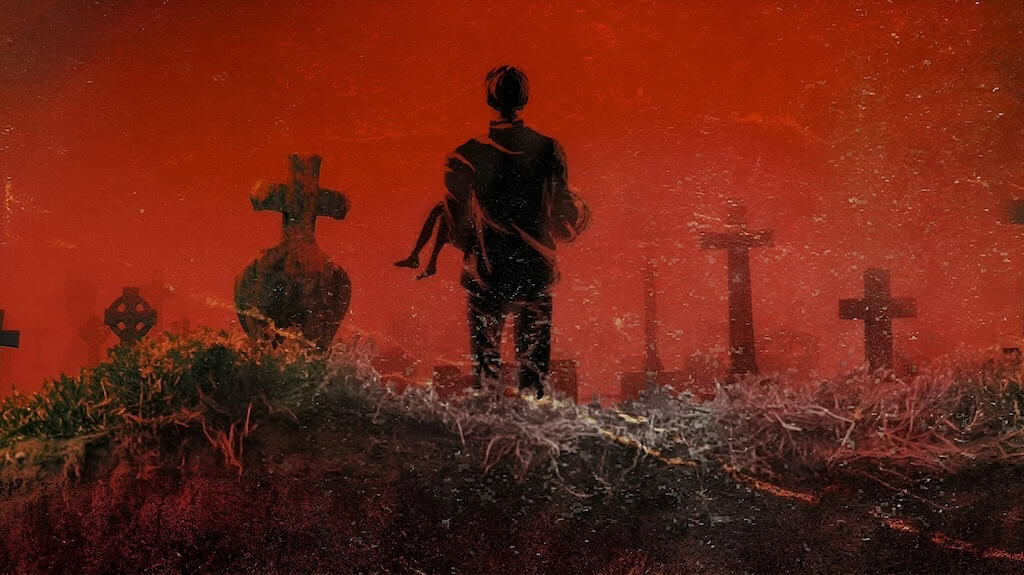
Pet Sematary is undoubtedly one of Stephen King’s more gruesome outings. Pet Sematary laces the grief and pain of losing a loved one with the selfish need to turn back time. However, death cannot be cheated without a devastating price, and we soon learn that sometimes “dead is better”.
The book has two cinematic outings (1989 and 2019), but for me, Mary Lambert’s 1989 version remains the most faithful to Stephen King’s material. Lambert brutally submerges Lewis Creed and his family in an escalating terror born of tragedy.
THE SHINING (1980)
By Neil Baker
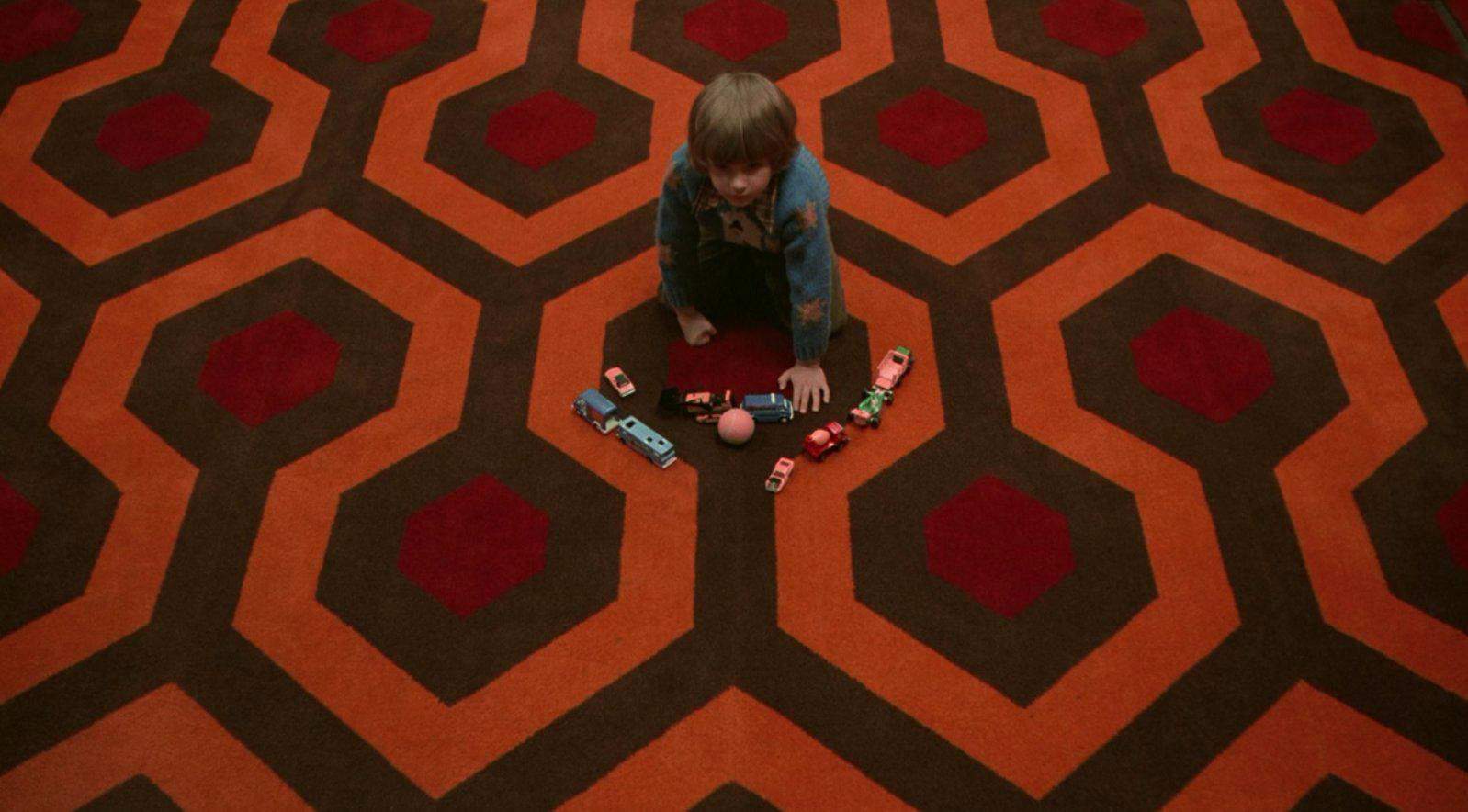
The Shining was my introduction to Stanley Kubrick’s genius, and my first real experience of the power horror films could wield. While it is now hailed as a masterpiece of modern cinema, The Shining did not find universal favour on its initial cinema release, receiving mediocre reviews, snubs at award ceremonies, and even a Razzie nomination for ‘Worst Director’. Even Stephen King, the author, rejected Kubrick’s adaptation.
Kubrick made several significant changes to King’s book, altering the narrative path Jack, Wendy, and their son Danny would take, and adding multiple layers to the story, from the horrors of colonialism to a fractured American dream.
Over the years since its release, Kubrick’s ability to weave mystery, unspoken words, and complex social issues into his movies has led to countless theories, some sound and some slightly far-fetched, as viewers, critics, and documentarians have attempted to decipher Kubrick’s maze of messages and ideas. For me, the true genius of The Shining sits not in the supernatural but in the human horror of a fragmented America built on colonialism.
Like the Donner Party, the Torrence family seek escape and a new beginning, only for the shattered American dream that follows them to eat them alive in the confines of The Overlook Hotel. The Shining shines a light on a fractured America that most Americans would rather ignore, one where addiction, violence, hyper-masculinity, and fear sit behind the door of many typical American homes in a country built on conflict, addiction, colonialism, racism, and division.
In Kubrick’s The Shining, the Overlook Hotel is the end of the road for a family who can no longer run from the truth. It is a place where the so-called American dream is shown for what it is: a colonial fantasy built on falsehoods, blood and flights of fantasy that hide much darker truths.
DOCTOR SLEEP (2019)
By Neil Baker
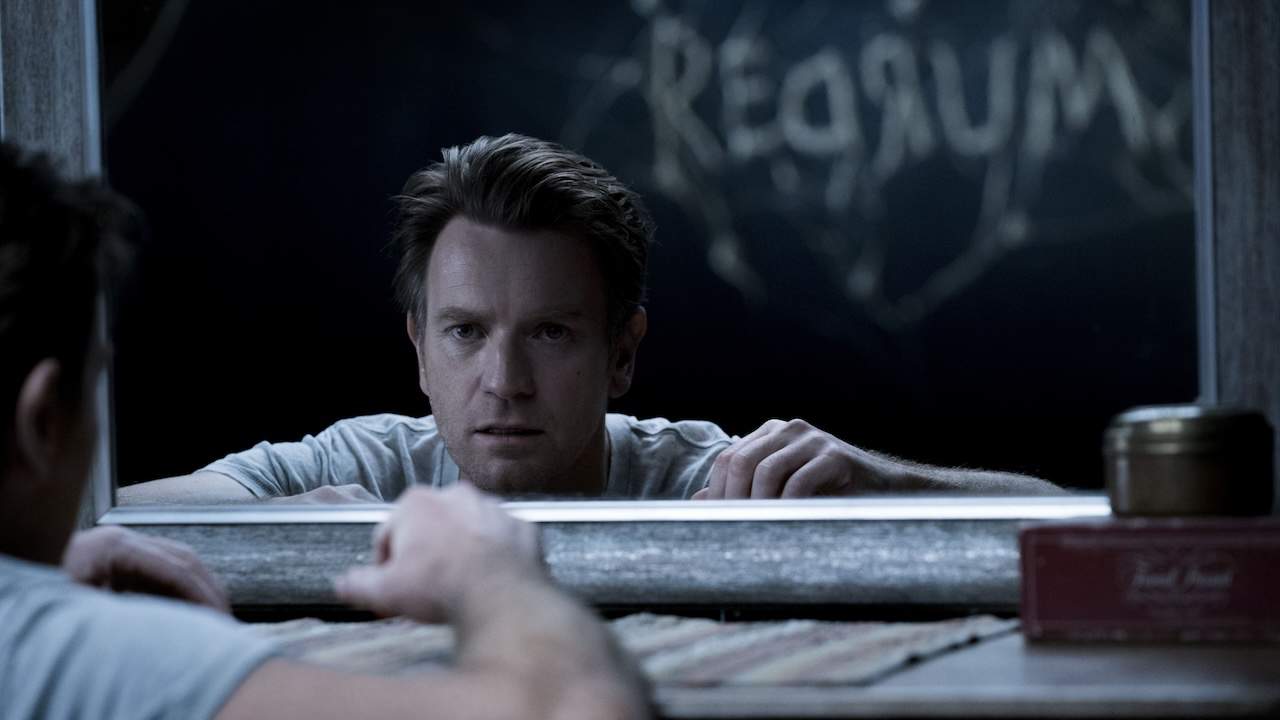
It’s no secret that King wasn’t a fan of Kubrick’s 1980 version of his 1977 novel, The Shining, or that King’s 2013 sequel to his book, Doctor Sleep, was always going to be challenging to adapt due to Kubrick’s masterpiece deviating from his material. Therefore, it is fair to say that director Mike Flanagan had a tough job when he took on Doctor Sleep; after all, how do you please the die-hard fans of Kubrick’s 1980 film and those who loved King’s 1977 and 2013 novels?
Mike Flanagan managed the balancing act and delivered one of the best and most underrated horror films of 2019. Flanagan’s movie captures the beauty and terror of Kubrick’s 1980 horror masterpiece while honouring Stephen King’s sequel, creating a bridge between the two.
Flanagan and King introduce us to one of the most terrifying characters of recent years, Rose the Hat, played brilliantly by Rebecca Ferguson, but it is a young Jacob Tremblay who makes this a terrifying work of genius. In a single scene, a talented young actor, an experienced ensemble and a visionary director offer us one of the most horrific, powerful and nerve-shredding sequences ever committed to film.











Follow Us