

Page 3 – Let’s Talk About Sex! Movies
X (2022)

By Neil Baker
Horror and sex have been intrinsically linked since the creation of the motion picture. From the rampant sexuality of the vampire, as it sinks its teeth into a victim, to the sexual vulnerability of two stalked young teens making out before their murder. Sex, fear, and horror go hand in hand. The slasher sub-genre, in particular, is often viewed as being driven by sex. Here, not only is the ‘final girl’ threatened by a male murderer, but she is generally a virgin who doesn’t engage in sex like the other girls who are offed in the opening hour.
Meanwhile, in the rare case of a ‘final boy‘, the young man’s sexuality is often placed under the microscope because a dominant male figure threatens him. Both porn and horror understand that fear and excitement are linked in the human brain and often converge like an exhilarating but petrifying rollercoaster ride.
Ti West’s incredibly clever homage to the origins of the slasher genre, X, pays tribute to The Texas Chainsaw Massacre and Psycho, among others, as it explores the cinematic foundations of porn, horror and art. But far from being a mere blood-soaked cinematic seminar, West adds a new layer to the frame: our fear of sex and age.
If Good Luck to You, Leo Grande explored the power of rediscovering your sexual identity in older age; X demonstrated the horrors of an ageing body, the terror of losing your sexual identity and the fear of becoming sexually invisible. In West’s film, porn, sex, and pleasure are playthings of the young and the beautiful, and he isn’t wrong – look at the world of porn and moviemaking. In porn, careers are brief, and a mere wrinkle is the equivalent of a life-ending cancerous growth, while in Hollywood, youth and beauty always have and always will reign supreme.
West’s discussions on age, sexuality and horror certainly aren’t new; older people are regularly viewed as horrifying in films, from Norman Bates’ mother to the woman in the bathtub in The Shining. But West builds upon these depictions by further unpicking human fears of sex, age and sexuality in a world built upon youthful looks and ideals. Here, he asks whether the porn industry and the film industry helped create a world where people feel discarded in later life, or whether we made that world ourselves due to our obsession with youth and beauty.
RAW (2016)

By Neil Baker
Teenager Justine (Garance Marillier) may be a vegetarian as Raw opens, but after eating a rabbit kidney as part of a college hazing ritual, she quickly develops a taste for meat that can’t be controlled. French director Julia Ducournau’s debut feature isn’t just a delicious slice of modern horror; it’s a veritable banquet of discussions on sexual hunger and female empowerment. In Ducournau’s wild, vivid and gory celebration of womanhood, the body horror of Cronenberg is mixed with a genuinely unique exploration of a girl’s sexual awakening.
Ducournau explores the erotic nature of Justine’s insatiable new appetite before launching into a genuinely horrific final act where sex, desire and hunger take control. Like Bones and All, it’s clear not everyone will survive this buffet of body parts and discovery, but it’s also clear that Justine’s newfound confidence in her desires and wants knows no bounds.
Let’s Talk About Sex! Movies
RIALTO (2019)

By Neil Baker
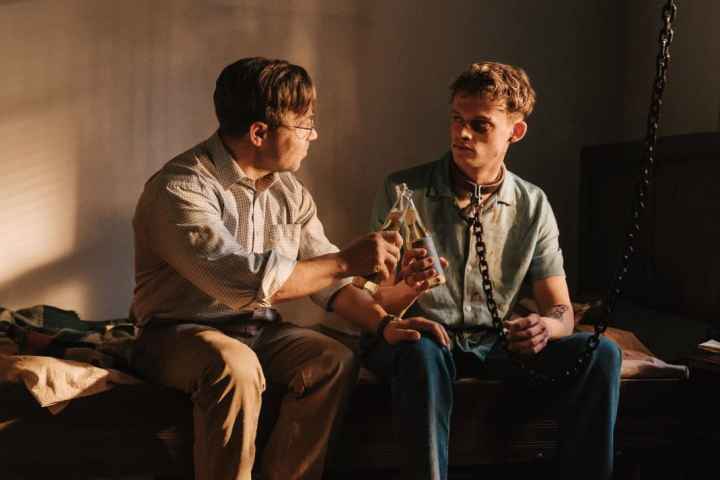
Based on Mark O’Halloran’s stage play, “Trade”, Peter Mackie Burns, Rialto, is a stunning and nuanced journey into repression, guilt, belonging, and identity through the complex relationship between a teenage rent boy and a father whose life is spiralling out of control.
In O’Halloran and Mackie Burns’ tale, two men sit on the verge of society, one through hardship and the other through self-repression. Colm (Tom Vaughan-Lawlor) has spent his life working the docks of Dublin, his very existence symbolic of the steel units he cares for, as he compartmentalises his life.
Following the death of his controlling father, a man he could never please, and the growing risk of redundancy at work, Colm turns to alcohol as a crutch, but booze isn’t enough as he seeks sexual release through a secret toilet rendezvous with a local rent boy called Jay (Tom Glynn-Carney). However, as he shuffles into the cubicle with the blond-haired boy, fear and apprehension surround him, and the encounter quickly fizzles into anxiety and regret. But Colm has dropped his wallet, and the savvy young hustler has picked it up, knowing there is an opportunity to scam the nervous “straight” man for money. But a relationship that starts as blackmail soon morphs into something different as both men become a crutch for one another, as a deep exploration of masculinity and sexuality comes into view.
Trade/Rialto offers an intimate character study of a man on the verge of emotional collapse and a teenage hustler trying to hold his life together by any means. The sexuality of Jay and Colm isn’t the centre of attention, as both men search for something far more difficult to define: a sense of belonging and security in a world of fixed masculine ideals. Here, Colm screams for escape despite the love of his wife and kids, while Jay longs to return to his newborn daughter and a girlfriend who gave up on him long ago.
Trade/Rialto is a story of mutual support and therapy at a price, as passion, fear, and secrets are brought into the light with explosive results.
QUEER (2024)

By Neil Baker
Set in Mexico City in the early fifties, Queer follows William Lee’s (Daniel Craig) pursuit of a younger man, Eugene Allerton (Drew Starkey), a sexy American drifter whose true sexuality and desires are never wholly explicit. Lee is also an American seeking escape and freedom in the bars of Mexico City. Here, he can feed his drug and alcohol addiction freely while at the same time indulging in sex free from persecution or discussion, sometimes with rent boys and always with the chiselled beauty of a younger man. He is a wolf in a sweat-drenched white suit, constantly stalking his prey, ready to pounce at any opportunity. But Eugene is different to the rent boys or passing travellers Lee is accustomed to. His beauty is magnetic, his presence electric, and his conversations mysterious. He is an alluring enigma Lee cannot solve, a puzzle box Lee must own but will never understand.
Guadagnino‘s bravery in adapting Queer should not be underestimated, nor should the skill of screenwriter Justin Kuritzkes (Challengers) in unpicking this knotty literary maze. Burroughs’s work is notoriously difficult to adapt, and the overt and covert themes, as well as its unfinished nature, presented Guadagnino and Kuritzkes with a unique challenge. But they rose to this challenge by creating a hypnotic, haunting and intensely erotic puzzle box of a movie.
Every frame of Queer is brazenly bold, enticingly seductive, and utterly timeless, from Mexico City’s ageing French Art Deco buildings to the surrealism of Lee’s drug-fueled episodes and a jungle expedition in search of an emotional bond.
Queer is a movie designed to be felt rather than merely watched, a multi-sensory experience that defies simple explanation. It is a film that carves an eternal place in your memory.
Let’s Talk About Sex! 24 movies
RISKY BUSINESS (1983)

By Neil Baker
Released in 1983, Risky Business would break new ground in the teen sex-comedy genre while introducing the world to Tom Cruise. Directed by Paul Brickman, many assumed Risky Business would play with the classic comedic riffs of Porky’s (1981) or Private Lessons (1981); however, like Fast Times at Ridgemont High the year before, Brickman’s movie would offer a far more thought-provoking exploration of teenage dreams, reward, risk and consequence.
Set in the suburbs of Chicago, Risky Business introduced us to the Grade-A student Joel Goodsen and a capitalist world of risky ventures while his middle-class parents are away. However, while these ventures are transformative in both personal and financial ways, they also carry significant risks. It’s a film that reminds us of the drive many young people carry and their naivety about the pitfalls that may lie ahead, but more than that, it reflects a newly emerging culture of money, sex, and power as the smoke and mirrors of the 80s American dream took hold.
STRANGER BY THE LAKE (2013)

By Neil Baker
For many men, the excitement, apprehension, fear and desire of cruising for sex remains a core part of their world, whether in person or online. These secret, clandestine and often risky public encounters transcend simple labels in a secretive world where sexual identity is obscured by desire. Over the years, the act of cruising has been explored in several thrillers, but in 2013, it truly came out of the closet with Stranger by the Lake, a thriller steeped in themes of trust, desire, fragility, masculinity, and connection. Alain Guiraudie’s film burns bright with the sheer heat of male sexual desire in a slow-burning mystery thriller that is utterly captivating and beautiful.
Stranger by the Lake is not only a groundbreaking LGBTQ+ thriller but also a commentary on blind love, the need for belonging at any cost, and the choices we make when searching for a quick release or a more meaningful connection. The result is an atmospheric, Hitchcockian thriller that works on multiple levels, leaving its audience with a nail-biting cliffhanger Hitchcock himself would be proud of.
Let’s Talk About Sex! Movies
HIGH LIFE (2018)

By Neil Baker
In an unspecified future, young criminals on death row are sent on a one-way journey: their mission is to gather scientific data on a black hole’s energy. The isolation of their trip provides an opportunity for each man and woman to contemplate their crime and repent of their sins; however, as they speed through the universe, their bodies succumb to the effects of deep space travel, their lives controlled by drugs and forced medical experimentation. Monte (Robert Pattinson) and a baby girl are alone and isolated on a drifting ship as Claire Denis’ science fiction story opens, but it’s not long before we are taken back to a time when the ship was full of convicts, each a guinea pig for Dr Dib’s (Juliette Binoche).
Claire Denis’ masterful movie strips back the human experience to its base components of sex, reproduction, protection and survival, exploring the animalistic triggers that all humans are subject to within the confines of a biblical floating ark of sexuality, desire and punishment.
REPULSION (1965)

By Agnes Sajti
Roman Polanski’s first English-language film is quite possibly one of the most influential psychological horrors of the 1960s. Opening in London, the plot follows Carol (Catherine Deneuve), a manicurist living with her older sister, Helen (Yvonne Furneaux). It is apparent early on that Carol struggles with daily interactions and seems to be repulsed by men to an extreme extent – when her suitor, Colin (John Fraser), tries to kiss her, she immediately brushes her teeth. At the same time, she almost throws up from the odour of a shirt left lying around by her sister’s boyfriend, Michael (Ian Hendry). As Helen and Michael leave for a trip abroad, the story moves to the flat’s confines, where we witness Carol’s slow descent into insanity with haunting precision.
Polanski parallels Carol’s fragmenting mental state with the suffocating and slowly deteriorating interior of the flat, thereby creating the first part of his so-called “Apartment trilogy,” which also included Rosemary’s Baby (1968) and The Tenant (1976). There is clearly a basis for Carol’s neurological and mental breakdown, yet the film does not include a “professional” character (like the psychiatrist at the end of Psycho) to explain or rationalise her psychosis, a key element of similar films of the time.
Repulsion’s atmosphere, set design, and surreal hallucination sequences create a unique and chilling psychological experience. However, the film’s greatest asset is Catherine Deneuve, an unknown 21-year-old French actress at the time of the film’s release, whose performance elevates Repulsion into an undeniable masterpiece of 1960s horror.
EDWARD II (1991)

By Neil Baker
Was Edward II gay? There is almost no way for us to answer that question with any certainty; after all, our modern labels of sexual orientation didn’t even exist in 1307. However, Edward did have an intense, close relationship with Piers Gaveston and a far less intimate one with his wife, who would depose him.
It’s clear that Edward I felt the need to banish Gaveston to France in 1306, despite Piers and Edward having been ‘very’ close friends since boyhood. Of course, Edward II reversed this decision as soon as he was crowned.
Derek Jarman’s exquisite, bold, and brave drama, starring Steven Waddington and Andrew Tiernan, is bathed in homoerotic visuals as Jarman takes us down an unconventional narrative path. Jarman uses Edward’s story to explore the homophobia and alienation still rife in Britain at the start of the 90s: just look at how Gaveston is strangled by a modern-looking policeman with a baton.
As a result, while the narrative may be historical, Jarman suggests that Edward’s story would unfold similarly in 1990s Britain, rendering it a cutting and challenging work of cinematic art.
LONESOME (2023)

By Neil Baker
Writer-director Craig Boreham’s fascinating ode to the wanderer is wrapped in a physical intimacy rarely captured on film. Boreham would turn to Grindr in casting, leading to a raw, unfiltered style of performance that owes much to Gus Van Sant’s My Own Private Idaho and John Schlesinger’s Midnight Cowboy. Casey (Josh Lavery) is a country boy drifting through the big city, arranging a series of hookups for cash.
But Casey’s journey from the outback to Sydney is not the story of a rent boy travelling from town to town earning a trade; it’s the tale of a damaged young man escaping his past through sex, his map torn and his destination uncertain as he walks the streets with a bottle of ‘Jack’ in his hand. On meeting the fiery and confident Tib (Daniel Gabriel) during a threesome, Casey finds something new, a man he can connect with physically and emotionally.
In Lonesome, sex flows through the veins of the story, from tender moments of connection to aggressive encounters and steamy group sessions. But at the centre of this carnal flow sits a beating heart, full of conversations about trust, healing, self-worth, and personal rebirth. Boreham’s film is about intimacy, both physical and emotional, and as a result, Casey’s journey is rich in texture, imagery, heat and sexual energy.
Let’s Talk About Sex! Movies
THE DOOM GENERATION (1995)

By Neil Baker
Twenty-nine years on from its premiere, The Doom Generation still retains the award for one of the most fucked up film endings ever! But aside from its shocking conclusion, the second part of Gregg Araki’s “Teenage Apocalypse trilogy,” following Totally F***ed Up, remains one of the most audacious, fascinating and brave teen movies of the 90s. Its endless pop culture references, razor-sharp wit, and discussions of gender and sexuality continue to speak to our modern society; in fact, some would argue that its messages are even more urgent today, given the current political turmoil in the United States.
Labelled as a “heterosexual movie,” during the opening credits, The Doom Generation is anything but, as two teens pick up a violent, handsome drifter who sparks their interest and desires as a series of violent events unfold. In Araki’s twisted, sexy and brutal world, themes of sexual conformity, liberation, id, ego and superego combine to create a movie that demands multiple viewings, no matter how challenging the finale may be. And talking of that finale, as Araki nears the final gut-wrenching, upsetting, violent and sad conclusion, The Doom Generation’s message becomes clear: the darkest corners of society will always seek to destroy anything beautiful that deviates from their binary view of gender and sex.
The Doom Generation is a one-off gem of 90s independent cinema that has never been equalled in its ability to weave psychosexual themes with the changing experience of youth in the 90s.
NOWHERE (1997)

By Neil Baker
Two years after the brutal and shocking finale of The Doom Generation, Araki would return with Nowhere, completing his trilogy. Nowhere would focus its lens on the paranoia of teenage life as the millennium came into view.
How many of you had discussions in your youth about the end of the world, dying young or surviving in a barren landscape where your friends and family had been wiped off the face of the Earth? Our teenage minds are a tangled mixtape of emotions and thoughts at the best of times, but when you add to that the raging hormones of our newfound desires, everything can seem pretty fucked up. We can feel alone, with nowhere to go.
Nowhere’s apocalyptic, drug-fuelled orgy of teenage dread, starring, among others, James Duval, Nathan Bexton, Christina Applegate, Ryan Phillippe and Rachel True, is as sharp today as it was in 1997, reflecting the anxieties, fears and hormonal rush of teenhood through a series of interconnected vignettes.
Brave, bold and utterly compelling, Nowhere would conclude Araki’s “Teenage Apocalypse Trilogy,” but it would also set the scene for the 2004 arrival of one of his greatest films, the haunting and powerful Mysterious Skin.











Follow Us