


Whether the untimely passing of Hamnet Shakespeare truly inspired Hamlet is pure speculation, yet it has formed the basis for Chloé Zhao’s engrossing comeback film at this year’s BFI London Film Festival. As broad in its narrative as it is in its emotional resonance, Zhao has crafted a tender, heart-aching ode to family and how loss forms the basis of great art and our deepest sense of humanity.
What inspires our greatest stories? It’s something that those most acutely interested in reading and writing often ponder. Even the works of the classic greats, be it from the Brontë sisters or Charles Dickens, had to have been inspired by something. Chloé Zhao’s Hamnet, based on the book by Maggie O’Farrell, serves as historical fiction, in the same vein as Milos Forman’s masterpiece Amadeus. Yet, its setup is rooted in this question, and the answers it finds amount to another terrific piece in Zhao’s impressive filmography.
Loosely inspired by the life and family of the legendary William Shakespeare, the film opens with a young 16th-century woman, Agnes (Jessie Buckley), alone in the woods handling her pet hawk. She is seen as an oddity among her rural community, with one rumour suggesting that she is the daughter of a forest witch. However, she attracts the attention of a young William Shakespeare (Paul Mescal). The two take a liking to each other and gradually fall in love, despite the disapproval of their respective families.
One may see parallels with Romeo and Juliet, but the central themes come into light with the birth of their three children: Susanna (Bodhi Rae Breathnach) and twins Judith and Hamnet (Olivia Lynes and Jacobi Jupe, respectively). Complications surrounding the birth of Judith leave Agnes fearing for the life of her children, an anxiety heightened by William’s frequent trips to London to showcase his plays. When the ultimate tragedy occurs, and Hamnet dies at the age of 11, Agnes and William are left to pick up the pieces, with their shared journey of love and loss laying the foundations for the Shakespeare classic, The Tragedy of Hamlet.
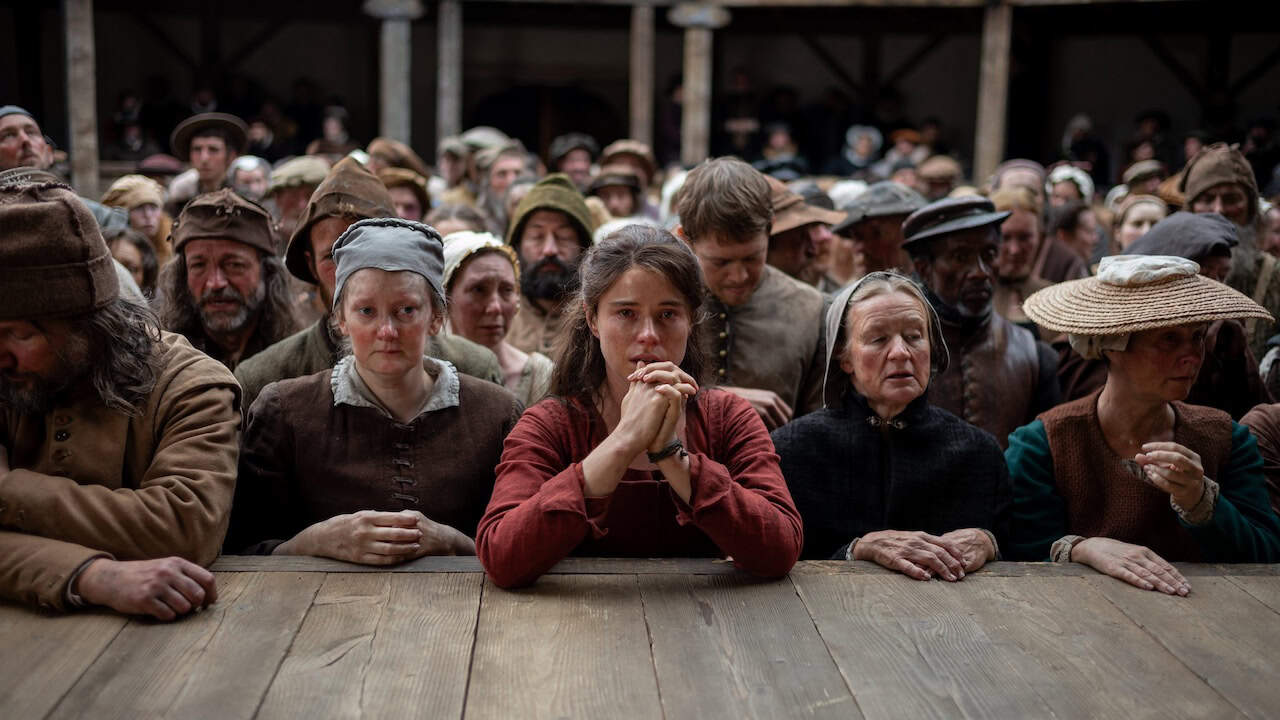
Rather than a straightforward biopic about the writing process of Hamlet, the film, like O’Farrell’s novel before it, is more broadly interested in the emotions and experiences that lay the foundations for great works of art. Its central argument is that grief is one of, if not the most powerful, engines behind art and life. It binds family and relationships with the same profoundness as love, and perhaps arises from just how strong love can be. The burden of parenthood is protecting children from the dangers of the wider world, with grief being preventable but, eventually, inevitable. That emotion informs so much of our best literature and media, and consequently resonates with the masses, precisely because we have, tragically, all felt it in some way.
By setting this story in Shakespeare’s time, Zhao and O’Farrell, who wrote the screenplay together, demonstrate the enduring prevalence of grief, loss, love, and the tribulations of parenthood throughout history. It’s a resoundingly poignant sentiment.
Whether it’s the Best Picture-winning Nomadland, the Indie darling The Rider, or the ambitious, if messy, Eternals, Chloé Zhao’s films were made for the term ‘every frame a painting.’ Her dazzlingly visual approach to storytelling yields eye-popping images throughout Hamnet. The idyllic rural landscapes of the Shakespeare home and surrounding village are captured through wide and overhead shots, the greenery and organic environmentalism of the setting exuding a tranquillity within Lukasz Zal’s sundrenched cinematography.
That peacefulness is destroyed by the harsh use of shadows and the tight framing that accompanies character close-ups, ominously highlighting the overt and subtle torment affecting the characters. One striking visual depicts William hunched over his desk, writing in candlelight against the backdrop of darkness, his figure near the bottom of the screen and hunched over. He’s a literary giant made to look small under the weight of pressure and uncertainty. Following Hamnet’s passing, those same wide spaces that once exuded love and calm now exude a devastating loneliness and hollowness, particularly in their framing of Agnes. If there were no dialogue at all, the weight of the characters’ grief would still be evident. It’s an elegantly directed picture whose vast canopy of striking imagery stays in your mind long after the credits.
While Shakespeare is one of history’s most well-known writers, Hamnet is more of Agnes’s story than his, although William is undoubtedly a constant presence. It’s often easy to forget that these celebrated creatives were human beings with their own flaws. Captivating performances, especially from Jessie Buckley, bring these traits to the fore. Buckley has been on fire since Wild Rose, and seemingly nothing can extinguish her. Her portrayal of Agnes’ desire for understanding and turmoil over the fate of her children is nothing short of miraculous. Here, her work is as organic as it is heartbreaking, with the sound design occasionally aiding the power of her range.
Mescal’s presence is more limited, but he still has significant moments when his character’s mask slips and the deeper wells of passion and sorrow are laid bare, whether through his actions or his writing. Other standouts include Emily Watson as William’s mother, with one contrast between her blunt dialogue and heartbroken face serving as a tragic visual, and even the youngsters playing the Shakespeare children, all of whom embody their roles with an authenticity and maturity beyond their years. My fellow critic, Alex Gilston, was so taken by the child performances that he quipped that Zhao must have “gone to the Steven Spielberg school of directing children”. I couldn’t have put it better myself.
If there’s a criticism to be made about Hamnet, it’s that it’s relatively slow to get going. Unlike O’Farrell’s novel, which told its story out of sequence, the script takes a firmly chronological approach. The reasoning behind this is understandable, especially given the novel’s dense content. However, it does take its time, and that’s not always to the film’s benefit, as the first act of courting between Agnes and William, as well-crafted as it is, perhaps goes on a touch too long. It’s a film that occasionally feels its length. That being said, the time spent in their company, building their romance, makes the later scenes of devastation and thematic payoff that much more extraordinary.
Whether the untimely passing of Hamnet Shakespeare truly inspired Hamlet is pure speculation, yet it has formed the basis for Zhao’s engrossing comeback film. As broad in its narrative as it is in its emotional resonance, Zhao has crafted a tender, heart-aching ode to family and how loss forms the basis of great art and our deepest sense of humanity. It may well be her second shot at winning the Best Director Oscar. Whatever happens, Chloé Zhao seems to be back in all her glory, and this critic cannot wait to see what’s next for her.










Follow Us