

Johnny Depp’s, Modi: Three Days on the Wing of Madness is at best pretentious and at worst as lifeless as the paintings its doomed protagonist pores over.
I can already feel the wrath of the internet for this hot take, but Johnny Depp hasn’t given a good performance in years. 2007’s Sweeney Todd was the last compelling role he delivered, as his eccentric shtick has quickly grown tired and charmless, the more he has relied on it. Depp finds himself behind the camera for this picture, the clumsily titled Modi: Three Days on the Wing of Madness, yet his directorial efforts are just as fruitless. While there’s an element of experimentation that’s perhaps admirable, the film proves to be at best pretentious and at worst as lifeless as the paintings its doomed protagonist pores over.
A historical biopic set in Paris during the First World War, Riccardo Scamario plays bohemian artist and sculptor Amedeo “Modi” Modigliani, during a rough patch of his life. Disheartened by the destruction of the war around him and disillusioned by his lack of artistic success, Modi has been left to wander through the deserted streets of Paris. Little inspires him, and there’s even less to do other than drink with his artist friends Utrillo and Soutine (Bruno Gouery and Ryan McParland, respectively), the three of whom behave more like they’re in a vulgar Marx Brothers comedy than wartorn Paris. The film follows three days in Modi’s life as he dodges bombs, police officers, and, most importantly, attempts to reconcile his lack of success with his own personal connections, namely with his English muse, Beatrice Hastings (Antonia Desplat).
The ambitions of Modi appear to be somewhat melancholic, as he finds himself unenthusiastic about his work amid war, yet drawn to create in spite of the destruction around him, whether it be the war itself or the criticism of his work. There’s an obvious, yet potent theme here about how creation is, in itself, a rebellious act and that any kind of artistic creation is, in itself, a radical cry against an establishment of compartmentalisation and destruction. The problem is that the film appears more interested in being flashy than sincere; it seems more concerned with appearing deep and creative rather than actually putting in the effort to be those things. As admittedly cynical as this critic is, it’s also somewhat ironic to have Johnny Depp, a man who has benefited enormously from the establishment, attempt to direct an apparent anti-establishment piece. It’s just another link in the chain of inauthenticity wrapped around this film.
Putting this aside, however, the film suffers from consistent tonal confusion. Despite the bleak setting of wartorn Paris and numerous observations about the difficulty of creating art under such conditions, the film frequently feels more like a comedy than a solemn drama —a paradoxical quality, given the conspicuous lack of laughter to be found. Depp cites Charlie Chaplin and Buster Keaton as inspirations in the film’s production notes. Sure enough, Modi and his cabal of misfits look like they’d go clothes shopping with Chaplin’s Little Tramp. However, where Chaplin and Keaton integrated their characters into their chosen narratives to deliver humour and poignancy, Modi’s characters act cartoonishly while ululating about the obvious themes, thereby robbing them of all endearment. Their antics and dialogue are frequently grating, with the reliance on swear words feeling childishly crass in execution. How smashing up restaurants and urinating in public in the name of art is meant to be interpreted as whimsical is anyone’s guess.
Hammy performances do little to alleviate the irritation. Scamario, to be fair, does have a certain pathos to the way he carries his character – a resignation that he’ll never be recognised in the ways that he once dreamed he would be. In another film, it would be quite the commendable performance; it’s just a shame that it often gets bogged down by the juvenility of the writing. Gouery and McParland’s efforts are nothing short of caricaturistic, with McParland’s stuttery accent undermining any emotional potential of the character. Meanwhile, Desplat feels criminally underused, her character serving as a bland love interest, her real-life writings only being acknowledged to promote Modi’s unsung greatness.
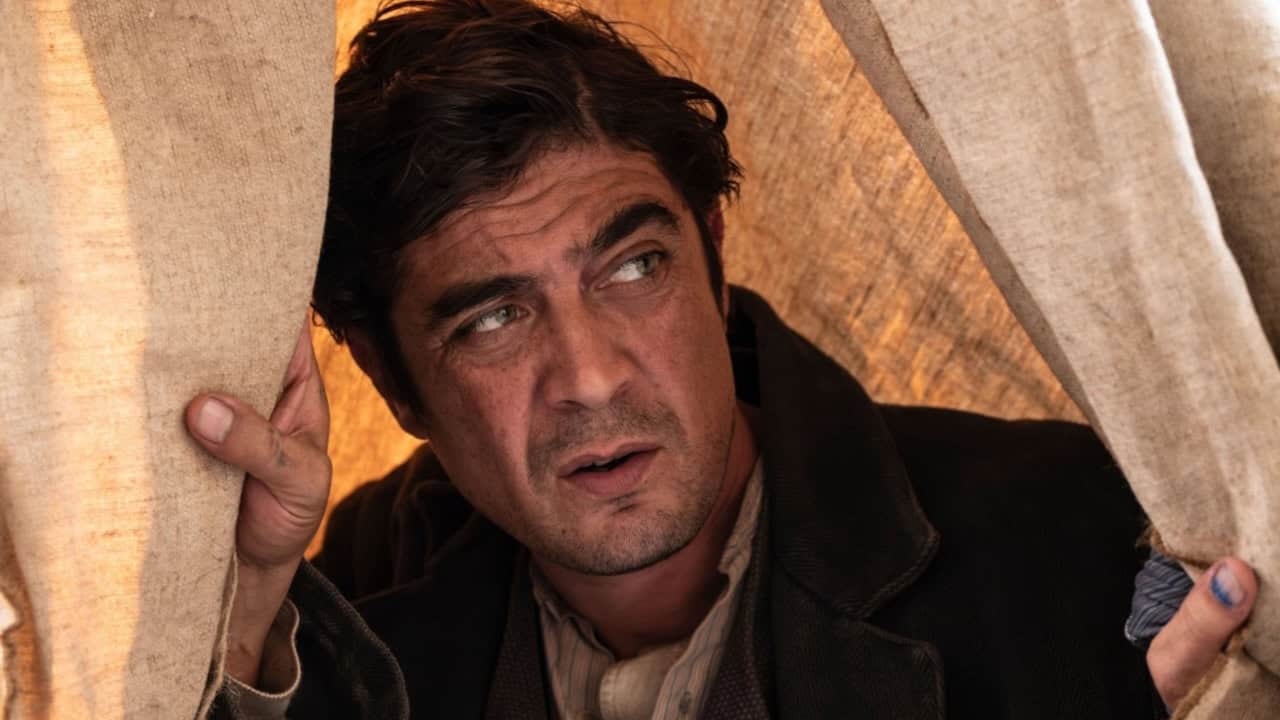
There is one exception, and that’s Al Pacino, who appears as a bureaucratic character for one key scene to meet with Modi. This scene, by a country mile, is the best in the film. This is mainly due to Pacino being such a great actor, who portrays a smug disingenuousness brilliantly here; it’s also where the themes of art and how it’s often dismissed by the establishment are best realised. The dialogue is sharper, the emotions of the characters feel genuine in their visual portrayal, and even the filmmaking, with the use of close-ups and rotating perspectives, generates a level of suspense unique to this scene.
Pity that the rest of the filmmaking is more puzzling than dazzling. The word “whirlwind” appears frequently in the production notes, and it’s a fitting description as the film seems to throw different styles of filmmaking into its recipe, seemingly because it can. The film mostly plays it straight, relying frequently on bland shot-reverse-shot techniques. But then, for maybe thirty seconds at a time in various places, the film suddenly becomes silent, borrowing visuals and shot compositions that make it seem as if someone has accidentally started playing City Lights. Perhaps they were included to highlight the power of art further, but given how sporadic these moments are, their inclusion is jarring. The mix of styles, imagery, and love-based ideas appears to be Depp’s attempt to evoke Marcel Carné’s Children of Paradise, cited as another inspiration in the production notes, but it comes off as messy rather than creatively mercurial.
What it leaves us with is a film that seems to have no idea who it’s aiming to please. Its celebrations of art feel more excessively self-indulgent than sincere; the narrative and craftsmanship quickly become scattershot, and ultimately, boring more than anything else. Its attempts at integrating the historical biopic with such a bizarre approach are perhaps worthy of some merit, but they do nothing to endear us to Modi, his work, or that of his counterparts. In that sense, the film fails to fully develop its themes and subject matter, resulting in a dull and vapid movie that comes across as yet another attempt by Depp to showcase his already weary style, while neglecting any worthwhile substance.
Modi: Three Days on the Wing of Madness is playing in select UK cinemas from 11 July












Follow Us