
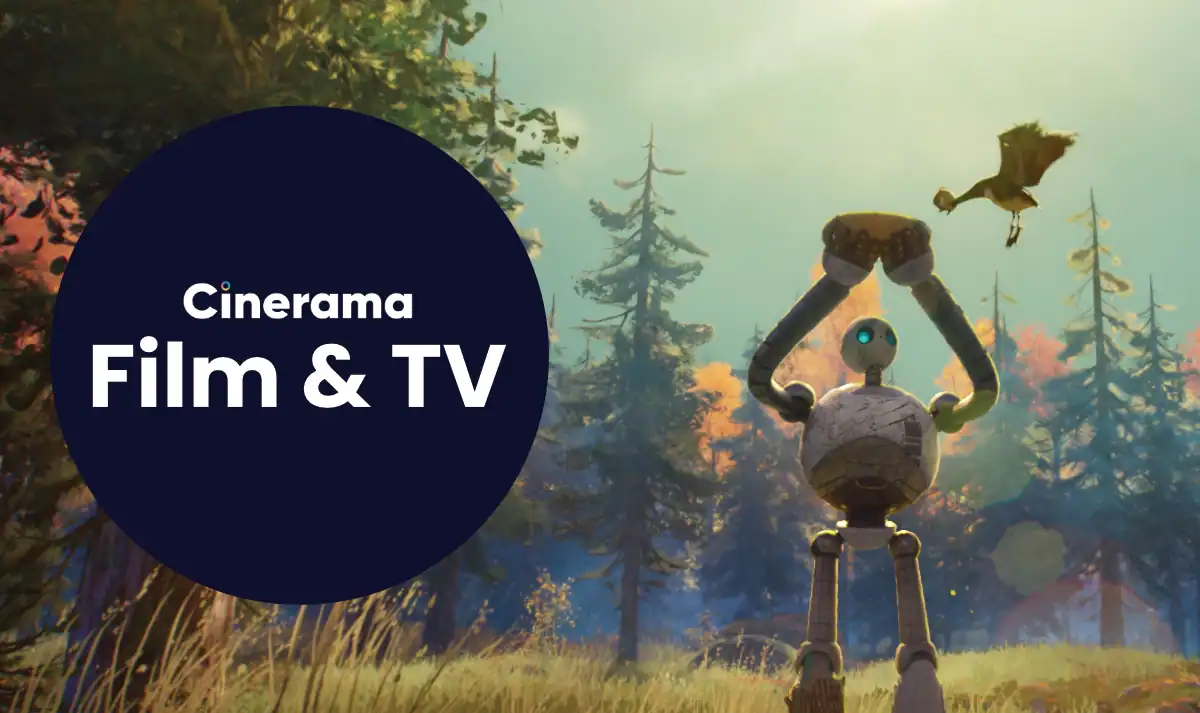
The Wild Robot screened at BFI London Film Festival and is now showing in cinemas nationwide.
There’s something bittersweet about The Wild Robot being DreamWorks’ final in-house animation. Over the years, the company has brought us some truly spellbinding works, from the epic Prince of Egypt to the hilarious and emotional Kung Fu Panda, How to Train Your Dragon films and the iconic Shrek. The in-house team possesses a catalogue that anyone would be proud of. The Wild Robot, the newest addition to this lineup, proves itself to be a stunning and riveting work of visual splendour.
Based on Peter Brown’s book of the same name, we open on a remote island. A cargo of six robots from the futuristic Universal Dynamics company crashes on the island, with the sole surviving robot being accidentally activated by the local wildlife. This robot, Rozzum 7134, aka Roz (Lupita Nyong’o), finds herself struggling to assimilate into the new environment. Programmed to serve humans, she has been left without a task to complete, and the animals of the island see her as a monster, owing to them not knowing where she comes from.
Roz finds a purpose when a gosling egg hatches in her presence. The young bird, who she later names Brightbill (Kit Connor), bonds with Roz, seeing the humanoid machine as his mother. Understanding Brightbill’s growth from gosling to a bird capable of swimming and flying as her new task, Roz teams up with a sardonic fox, Fink (Pedro Pascal), in order to raise Brightbill, with her efforts to do so, bringing her closer to nature and the animal community that inhabits the island.
Like previous DreamWorks pictures, The Bad Guys and Puss in Boots: The Last Wish, the colour scheme and visual aesthetic of The Wild Robot owes a lot to the Spider-Verse films. It’s a vivaciously colourful picture, the contrasting 3D models and 2D backgrounds fusing seamlessly and subsequently leaping off the page. The bright white of Roz’s model, occasionally personified by blue and red lines conveying benignity and danger, makes her stand out among the lush greens of the forest and the soothing blues of the sea and sky around them. That the film is so intrinsically linked to nature is a symptom of the story it’s adapting, yet it gives the film a Miyazakian feel with its emphasis on the healing power and communal spirit of the environment. Even Roz’s design is not dissimilar to those of the robot guards seen in Miyazaki’s underrated gem Laputa: Castle in the Sky. It’s an animated wonder whose vibrant colours, playful hybridising of styles and expressive character designs cause the picture to brim with life.
Community is the most apparent theme that emerges from this story via the harmony between Roz and the wildlife around her. As she learns to care for Brightbill and face the obstacles that threaten to tear the unlikely pairing apart, the more the animals on the island begin to interact with and ultimately accept Roz as one of their own. This makes for some delightful and funny interactions influenced by the idiosyncrasies of the characters. Brightbill’s initial copying of Roz’s robotic dialect (right down to vocalising the mechanical sound effects) is extremely cute, while Pedro Pascal relishes his role as the sly, mischievous Fink, a self-proclaimed “jerk” whose desire to use Roz to his own ends – especially if it means getting a meal – is gradually eroded by the genuine friendship and family dynamic that blossoms between the two. Other standout voice performances come from Catherine O’Hara as a put-upon mother possum and the ever-formidable Mark Hamill as a terrifying bear who acts as the island’s apex predator.

The emotional resonance of these fun scenarios cannot be understated. While the premise is simple and borderline conventional, the animation and the acting imbue it with such heart and soul that it becomes impossible not to lose yourself in the film’s picturesque images. Nyong’o is great at finding deeper expression within Roz’s mechanical dialogue, as per her programming. She makes even the most neutral of dialogue contain a tinge of emotion, something the animation heightens splendidly. When Brightbill at last takes flight, Roz watches him go, her eyelids lowering ever so slightly, a small but brilliant touch that adds sadness to her otherwise expressionless face. As Roz learns to shed her programming and embrace her role as a mother to Brightbill and a staple in the wildlife community, we, the audience, find ourselves increasingly mesmerised by the characters and their natural environment.
Some of the film’s uniqueness is lost in the third act with the reappearance of the Universal Dynamics company, spearheaded by a villainous robot named Vontra (Stephanie Hsu). While this portion of the story, which instigates the action-packed climax, is sufficient, even entertaining, it’s a frustrating development as feelings of not belonging and insecurity at one’s inner programming were the main antagonistic forces of the story. They might not be physical forces, but they beautifully drive the conflict. Incorporating a definitive villain somewhat undercuts the charm and innovation of this particular film, even if this segment of the story does, on a narrative basis, work reasonably well.
Nevertheless, The Wild Robot is as gripping as it is aesthetically gorgeous. It joins the ranks of Inside Out 2 as one of 2024’s finest animations, possibly surpassing the former for many audiences. Visually euphoric, stunningly crafted, and teeming with heart, it takes a story of nature and machines and transforms it into a fun and exciting fable about the spirit of community and the beauty of environmentalism. What a note for the DreamWorks’ in-house team to go out on!











Follow Us