

It’s difficult not to feel hopeless about the convincing case made in Orwell: 2+2=5. But one wonders whether it comes across primarily as confirmation bias. As much as the parallels between Orwell’s work and modern-day totalitarianism are terrifying, Peck’s documentary doesn’t offer much guidance on how to combat these evils.
George Orwell is one of the literary greats of the 20th century. Any one of his books – Animal Farm, Coming Up For Air and 1984, among others – is legacy-defining in its own right, but his ability to combine engrossing prose with pointed political critiques remains unmatched to this day. Raoul Peck’s documentary, Orwell: 2+2=5, takes particular interest in 1984, hence the title. In using Orwell’s most iconic book as a frame of reference, Peck and team partake in a compelling argument – one that is perhaps scattershot in delivery but horrifying in persuasion.
Initially, Orwell: 2+2=5 appears to be a documentary recounting of Orwell’s life, framed around his struggles to write 1984, which would ultimately be his last published novel. Archive photos, newsreels and a voiceover narration by Damian Lewis recount Orwell’s life, opinions and writings in a first-person manner. As an exploration of how one’s politics and worldview are shaped, the film offers an intriguing insight.
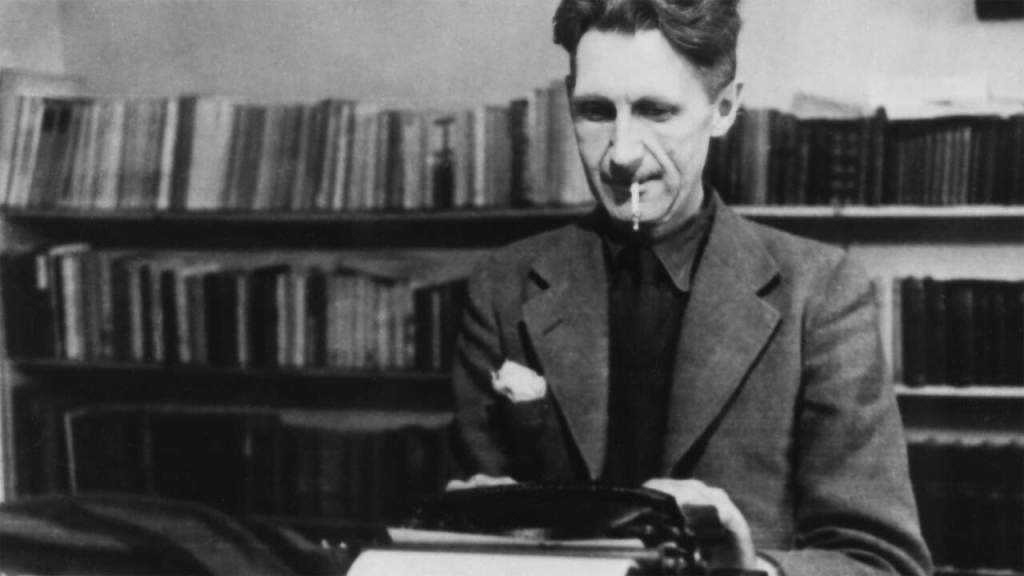
Yet the crux of the film’s argument comes with how it uses Orwell’s writings as a template for the modern world. 1984 was a dystopia in which the hero, Winston, struggles to retain autonomy and freedom of thought under a totalitarian regime. Peck and team argue that much of the world faces the same oppression Winston faced in his fictional setting. The novel was inspired partially by wartime propaganda during World War Two. In Orwell: 2+2=5, Peck investigates how the elements that inspired the novel still exist in ominous spades today, using ongoing historical events such as the genocide in Gaza, Russia’s invasion of Ukraine, the Myanmar Civil War, and Trump’s increasingly authoritarian hold on America as case studies.
1984 continues to strike a chord in part due to its potent portrayals of living under a corrupt dictatorship and the ways it controls the masses through surveillance, misinformation and constant mental bombardment. Peck cleverly strings together passages from the novel with footage of historical events, most, if not all, of which can be labelled as atrocities. Lewis’s voiceover, while a stand-in for Orwell himself, is rich with vulnerability and even a sense of helplessness as he reads the novel aloud, its words ringing with sinister dimensions, accompanied by footage of Gaza and the January 6 insurrection, among others. It’s a mode of communication in line with the explanatory mode of video essays and documentaries. Yet, the simplicity of holding both prose and reality side by side to highlight parallels is brutally effective.
The three paradoxical but disturbingly relevant slogans of 1984’s fictional regime were – Big Brother, War is Peace, Freedom is Slavery, and Ignorance is Strength. By showcasing how various contemporary regimes arose and operate, it’s hard not to see the chilling power of these slogans in real time.
Just weeks ago, Trump launched an attack on Iran, starting a war for seemingly no reason other than because he could, and claimed it was in the name of peace. Meanwhile, extortionate wealth inequalities see hard-working masses living paycheck to paycheck, slaving away while a handful of vulturous billionaires own all the media and most of the politicians. All the while, the public zone is flooded with misinformation, leaving many too exhausted or too deeply embedded to combat it. Whether in reality or fiction, all corrupt societies and totalitarian regimes operate, to some degree, under one or more of those principles. In weaving together text, footage, and political philosophy, Peck’s film uses the weapons of the audiovisual medium to attack modern inequalities and those who enable or uphold them.
One even gets a sense of Orwell’s own character. Via his prose readings and Lewis’s dictation, Orwell’s musings and despair paint a picture of a socially conscious man aware of injustice but at a loss for how to combat it other than using literature as a mirror. His own actions in wartime directly caused disillusionment with governmental powers, spawned by his guilty conscience. He expresses empathy for working-class struggles but acknowledges his own hypocrisy. He came from a middle-class background and thus notes that he can imagine but never fully know the experience of poverty and the constant hustle many in the working class face. People today can forget how vital empathy and imagination are in fighting for workers’ rights and social equality. In using Orwell’s words to inform the themes, Peck and team are expressing that same solidarity – a tiny light in the overbearing darkness.
This makes the film multi-dimensional but somewhat messy in its presentation. As ambitious as it is, the citing of multiple contemporary hardships can be a bit sprawling too – using quantity as a means of argument. There’s certainly no shortage of troubling crises and oppressive governments to choose from, but one wonders if a more refined focus on one or two contemporary events would’ve enhanced the argument.
Trump’s actions grow more Orwellian every day, and Israel’s treatment of Palestine would’ve made Big Brother swoon. The use of not just historical footage but of other fictional works – notably Ken Loach’s I, Daniel Blake and Riff-Raff – can add to the feeling of the film throwing things at the wall in the hopes of its argument sticking, an action it really doesn’t need to do given the strength of its argument.
It’s difficult not to feel hopeless about the convincing case made in Orwell: 2+2=5. But one wonders whether it comes across primarily as confirmation bias. As much as the parallels between Orwell’s work and modern-day totalitarianism are terrifying, Peck’s documentary doesn’t offer much guidance on how to combat these evils. Perhaps that’s a deliberate choice – 1984 ends in devastating fashion after all – but it gives the impression of a picture preaching to the choir, with those already taken in by the lies of Trump, Farage, Netanyahu, Putin and more unlikely to be swayed by the film’s highlighting of what’s obvious to many.
Nevertheless, there’s no denying the strength of conviction and craftsmanship. Peck commodifies Orwell’s most famous book, citing it to scrutinise modern-day totalitarianism, and while the presentation borders on overstuffed, the power of its argument is striking. At the very least, it serves as a reminder of what an articulate and observant writer Orwell was, with his words continuing to ring hauntingly true seven decades after his passing.
Orwell: 2+2=5 is showing in cinemas nationwide from March 27.













Follow Us