

The Super Mario Galaxy Movie is scientific proof that catering to the banal sensibilities of fanboys only hinders the creative process. Content coasting solely on its IP recognisability rather than telling anything of narrative or thematic substance, it’s lazy, histrionic, soulless slop.
It’s no secret that I despised The Super Mario Bros Movie. A vacuous nothingburger masquerading as kids’ entertainment, the film embodies everything wrong with modern-day fan pandering. The prospect of a sequel wasn’t exactly a welcome one, but then again, Super Mario Galaxy is one of my all-time favourite video games. Thus, I endeavoured to remain open-minded as I entered the press screening. Unfortunately, this sequel is also indolent and vapid, cynically using nostalgia to cover its cavernous cracks. It’s truly abysmal.
Created by Illumination and Nintendo, The Super Mario Galaxy Movie takes place some time after the original. Mario and Luigi (Chris Pratt and Charlie Day, respectively) have become permanent residents of the Mushroom Kingdom, led by Princess Peach (Anya Taylor-Joy). After an elongated sidequest whose sole purpose is to force the character Yoshi (Donald Glover) into the brothers’ conglomerate, the gang all meet to celebrate Peach’s birthday.
But the party is ruined by the news that Princess Rosalina (Brie Larson), mother of the Cosmos, has been abducted by Bowser Jr (Benny Safdie), the offspring of the villainous turtle from the last film, Bowser (Jack Black). Soon enough, Bowser Jr comes to free his father, forcing all of the characters to scatter across the universe. With a classic hero’s journey setup established, Mario, Luigi and co set off across the stars to rescue Rosalina.
Super Mario Galaxy is so brilliant, in part because of its vibrant, expansive imagination. There was a definitive, if not particularly intricate, story, but it was more concerned with providing various colourful worlds that the player could explore to their heart’s content, all to the tune of stellar music and a solid difficulty curve.
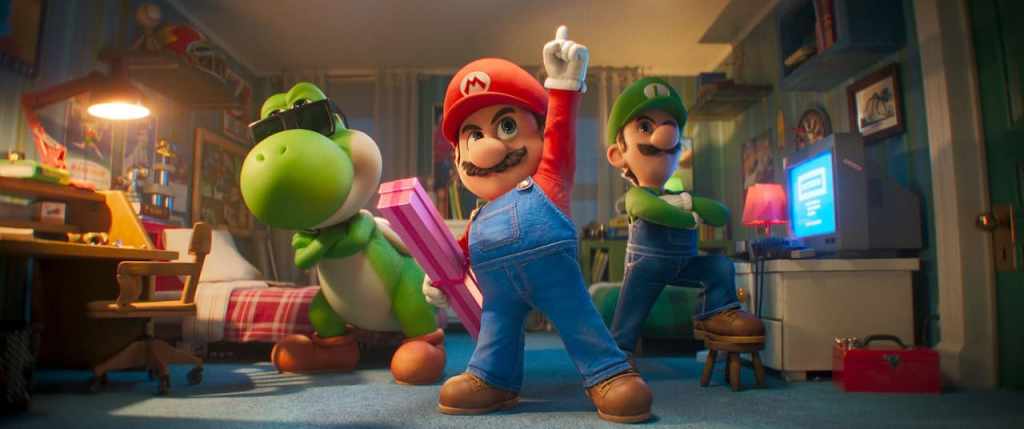
L to R: Yoshi (Donald Glover), Mario (Chris Pratt) and Luigi (Charlie Day) in Nintendo and Illumination’s The Super Mario Galaxy Movie, directed by Aaron Horvath and Michael Jelenic.
The Super Mario Galaxy Movie has a lot of darlings to kill if it wants to maintain its 98-minute runtime: so naturally it forcefeeds as many IP references down our throats as it can – including at least two from different Nintendo properties, one of whom becomes a prominent character. Instead of visual splendour telling a story – as is the job of a feature film – we instead get a glutted conveyor belt of Easter Eggs. The climax is an irksome game of spot-the-power-up item, all the supposed thrills built on recognising these random trademarks rather than any in-narrative stakes.
Many defenders of the original film called it a love letter to fans, something they’ll no doubt call this one too. My retort is that it’s not love to overdose someone on junk food. It’s irresponsible. This isn’t a film – it’s a sugar rush that overloads your senses without offering anything of nutritional value. The game gives you immersive, euphoric creativity. This is corporate regurgitation, devoid of ingenuity or care, as it rushes from one underdeveloped point to the next.
Take away the popularity of the Mario IP, and what are we left with? Practically nothing. No true character arcs. No earnest emotional resonance. Not even a real story beyond the bare-boned – certainly not the story presented in the game, at any rate. It’s shallow drivel designed to make you remember better forms of media rather than sell you its own unique experience, becoming, frankly, impossible to follow for those unfamiliar with the games. I’d argue that, like its predecessor, it’s made more for nostalgia-addicted men in their 30s than for kids. It’s so steadfast in catering to the worst, most entitled and regressive corners of online fandom that its microscopically thin plot actively undermines the otherwise solid animation.
Ear-bleedingly obnoxious performances prevent us from becoming numb to the laziness. One can feel the migraines coming every time Pratt, Day, Glenn Powell, Keegan-Michael Key, and more screech into their microphones, doing nothing to endear us to their characters through hammy deliveries. Bowser and his child are a morbidly sweet father-son pairing on occasion, but Black and Safdie succumb to the same traps of overacting as their protagonist counterparts. Larson and Taylor-Joy are probably the strongest here. Still, even the former is undermined by the fact that her character, a prominent figure in the original game, is relegated to a background role as a damsel in distress.
Speaking of background relegation, Mario barely feels present in his own film. The picture is juggling several characters and side quests at once, presumably so it can get more IP reference fodder. The plot jumps back and forth between four groups of characters so often that Mario’s already lacking agency feels non-existent. He doesn’t have an arc anyway – just a start and an end point – but his participation in the film feels so absent in urgency that the title borders on false advertising. In place of any growth as a protagonist for Mario, we instead get asinine editing, bloated, dizzying action, and bottom-of-the-barrel humour so tongue-in-cheek it’s a wonder the screen didn’t smash from the inside. The plot developments and character dynamics are all rushed, yet the movie still drags.
If we’re splitting hairs, then this film is an improvement over the first, albeit a very marginal one. There’s a certain lively colourfulness to the animation, even if much of it is eccentric to a fault, as is standard for Illumination. A scene involving a meteor show is an admittedly gorgeous visual amongst the sugary clutter. The bizarre reliance on pop songs in the first film has been replaced by a score that harkens back to the original Super Mario Galaxy soundtrack, which is really incredible. But these rare moments of appeal don’t distract from the sheer hollowness of imagination on display.
Defenders can label it a love letter to fans all they like – such is their right to an opinion and freedom of speech. For me, though, this is a film suitable only to the most nostalgically gluttonous of zombified audiences. Even junk food entertainment offers something of value beyond pointing at random IP traits and going “ohhhh I know that”.
The Super Mario Galaxy Movie is scientific proof that catering to the banal sensibilities of fanboys only hinders the creative process. Content coasting solely on its IP recognisability rather than telling anything of narrative or thematic substance, it’s lazy, histrionic, soulless slop. Thankfully, Super Mario Galaxy (available on the Nintendo Wii or the Switch 2) is genuinely amazing. I encourage those reading to stay home and play the game instead. You’ll save the money and the IQ points you would’ve lost from watching the utterly insincere rubbish that is this movie.
The Super Mario Galaxy Movie is showing in cinemas nationwide from April 1.














Follow Us