
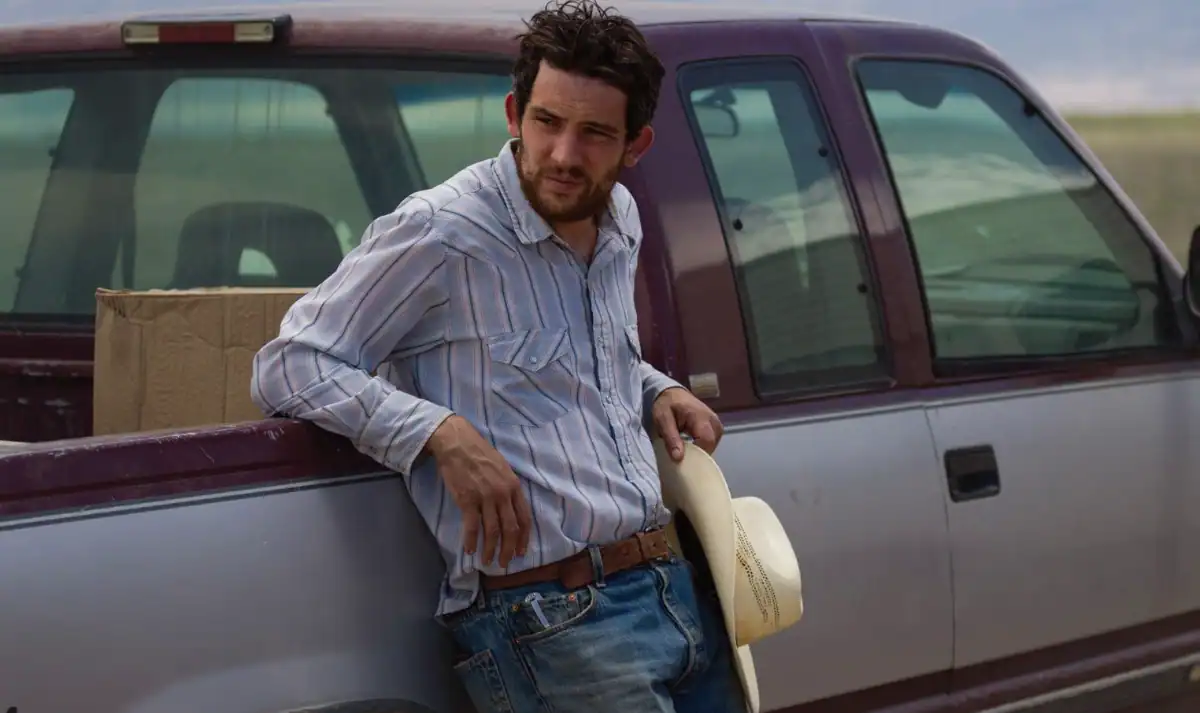

Rebuilding is one of those films whose trajectory is clear from the outset through its imagery and title. Yet the longer you watch it, the more you find yourself completely taken in by its profound sentiments and heartfelt direction.
Rebuilding is a film whose ambitions are pretty obvious from the get-go. The clue is literally in the title in this case. However, when sincerity is applied as deftly as this, one can forgive its more on-the-nose tendencies. This is a heartfelt, earnest drama whose organic portrayal of loss and resilience cannot be overstated. At the bare minimum, it’s yet another banger to add to Josh O’Connor’s increasingly awe-inspiring filmography.
Suitable for the neo-Western genre, Rebuilding opens with a scene of devastation. A forest fire has destroyed farmland in the San Luis Valley, Colorado. Among its casualties was the ranch of Dusty Fraser (O’Connor), a property that has been in his family for generations. As a result, the Federal Emergency Management Agency (FEMA) have placed him and other displaced people in a temporary trailer camp.
The sudden loss of his home has put Dusty in a strange place. On the one hand, he can spend more time with his ex-wife, Ruby (Meghann Fahy), and his young daughter, Callie-Rose (Lily LaTorre). But on the other hand, it doesn’t look as if he will be relocated any time soon. Thus, he has too much time to contemplate where he belongs, whether with his family or in the new community he has developed with other survivors of this forest fire.
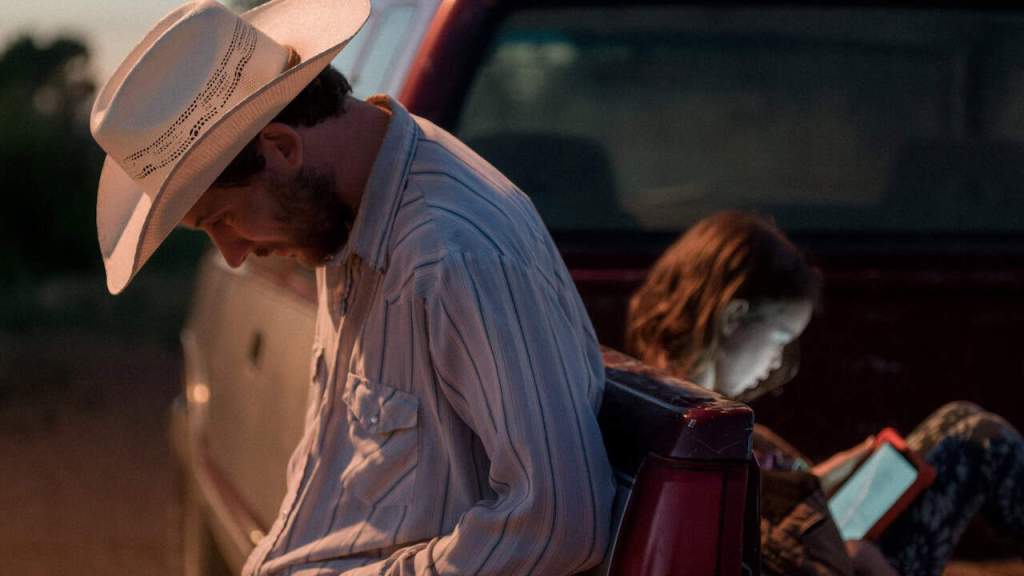
One can see parallels between Rebuilding and Chloé Zhao’s The Rider. This is partially due to the abundance of cowboy hats worn by Dusty, but mainly to the way both films use imagery to visualise the deeper emotions of their characters. Barren landscapes and closed-up properties dot the land of this film, the scorched earth being all that remains of the devastation that kick-started the story.
Alfonso Herrera Salcedo’s cinematography paints the scenery with a disquieting level of hopelessness – the vastness of empty earth captured from the wide shots evoking displacement on a deeper, emotional level as well as a literal, physical one. When Dusty takes Callie-Rose to the library, it is closed, so they have to sit outside and hijack the WiFi from Dusty’s pickup truck. It’s a bizarre image, but it evokes the feeling of living on the margins that makes the setting so authentic and the emotional resonance so unmistakably potent.
Writer-director Max Walker-Silverman previously wrote and directed 2022’s A Love Song, which detailed a complex dynamic between two childhood friends. His knack for intimate human drama is on full display here as he puts his protagonist in a nebulous position between family and shelter.
While Dusty’s relationship with his ex-wife and daughter is reasonably amiable, it’s also somewhat awkward, likely due to the nature of his and Ruby’s breakup. Yet Walker-Silverman is content to let the characters take their time. Rather than shoehorning contrived conflicts into existence, he simply lets the characters be. By putting them in difficult situations and allowing them to figure things out together, Walker-Silverman and team craft authentic, lifelike people whose emotions and struggles are actualised rather than mined for cheap drama. It’s a deliberately gradual pace, but one that you can’t help but find yourself swallowed up by via its earnestness.
Josh O’Connor has been on fire since his breakout role in God’s Own Country a decade ago. Whether it’s Only You, La Chimera, Challengers, or the 2025 double whammy of The Mastermind and Wake Up Dead Man, O’Connor has proven himself a versatile chameleon of an actor, able to showcase external and internal strife effortlessly. Dusty Fraser is one of his more internal, understated roles – Dusty mostly keeps hardship to himself, even in the thick of it all – yet O’Connor imbues the role with a quiet energy. Even when he’s saying nothing, Dusty’s anxiety and misgivings are evident in his movements and expressions. It’s a brilliantly calculated performance from O’Connor, bolstered by the myriad of supporting performances bouncing off of him.
Dusty, who is somewhat of a loner, is forced to interact with his new, unchosen neighbours as a result of the fire. Chief among them is Mali (Kali Reis of True Detective: Night Country), a single parent in a predicament similar to Dusty’s. Their interactions allow further insights into Dusty’s mental state through comparison, the raw honesty of their conversations showcasing the internal hurt the forest fire has caused – a hurt that Reis portrays with quiet tenacity.
Fahy is terrific as Ruby, juggling a delicate act of being sympathetic to Dusty’s predicament while also being annoyed at his lack of effort. Amy Madigan plays Dusty’s grounded but jubilant mother-in-law, a delightful presence to contrast the numerous sombre roles. Meanwhile, young Lily LaTorre goes toe-to-toe with her seasoned co-stars in the authenticity department, capturing a quiet pathos to Callie-Rose that’s well beyond her years.
Ultimately, Rebuilding is an ode to community and human resilience. The characters frequently feel hopeless in their situations, and the cinematography, lighting, and imagery turn these internal feelings into external imagery. Nevertheless, the picture pays homage to the ways we humans can find purpose and endurance through one another. Whether it’s small moments of the characters helping each other, or the overall arc Dusty finds himself in, this is a film that believes humanity is capable of anything when we put our minds to it.
The film’s deliberately slow pace and more introspective conflict may not strike a chord with everyone who watches, and the way it portrays its chosen themes is often obvious – one sequence involving a single green plant in a wasteland is particularly blatant. However, the sentiment behind its execution is so genuine, and the concluding resolution is so heartachingly earned that it’s easy to look past such flaws.
Rebuilding is one of those films whose trajectory is clear from the outset through its imagery and title. Yet the longer you watch it, the more you find yourself completely taken in by its profound sentiments and heartfelt direction. With gorgeous imagery and a belter of a performance from O’Connor, it’s a film that engrosses you so completely in its pace and themes that you could easily spend another hour in its company. Beautifully filmed and utterly sincere in its delivery, Rebuilding says little verbally but achieves so much visually and emotionally.


















Follow Us