


Rose of Nevada, playing at BFI London Film Festival, proves an engrossing and rewarding watch. An articulate rumination on the loss of tight-knit communities to modern precarity, to the tune of dazzling old-school filmmaking, Rose of Nevada often confuses but always mesmerises.
When I first saw Mark Jenkin’s Bait at the Glasgow Film Theatre in 2019, I was so taken by the uniqueness of its craft and depth of its storytelling that I bought another ticket and watched it twice back-to-back. I have been taken by Jenkin’s work ever since, with its proud Cornish identity and rambunctious willingness to experiment with old-school cameras and techniques. His newest feature, Rose of Nevada, appears to mark a step up the ladder for him, given the inclusion of mainstream actors alongside his usual roster. Yet Jenkin shows that he hasn’t lost any of his idiosyncratic touch in this ominous and puzzling, yet deeply resonant picture.
Set in a contemporary fishing village in Cornwall, a boat, the Rose of Nevada, mysteriously drifts into harbour. The vessel and its crew were presumed lost at sea thirty years ago, and although the boat has returned, the crew remains missing. Although perplexed by this eerie development, the village decides to put the vessel to work once more, catching fish to sell on the markets. Alongside the experienced but eccentric captain Murgey (Francis Magee), two young men come aboard as crew: the brash vagabond Liam (Callum Turner) and Nick (George MacKay), a young father who only wants the money to fix the roof and feed his wife and toddler daughter.
Rose of Nevada is a brilliant premise from the outset; one that slots in nicely with Jenkin’s laborious filmmaking style and dreamlike visuals – he writes, directs, edits and serves as Director of Photography here. Yet the film is labelled a science fiction, and it is only following the boys’ first trip out that these properties reveal themselves.
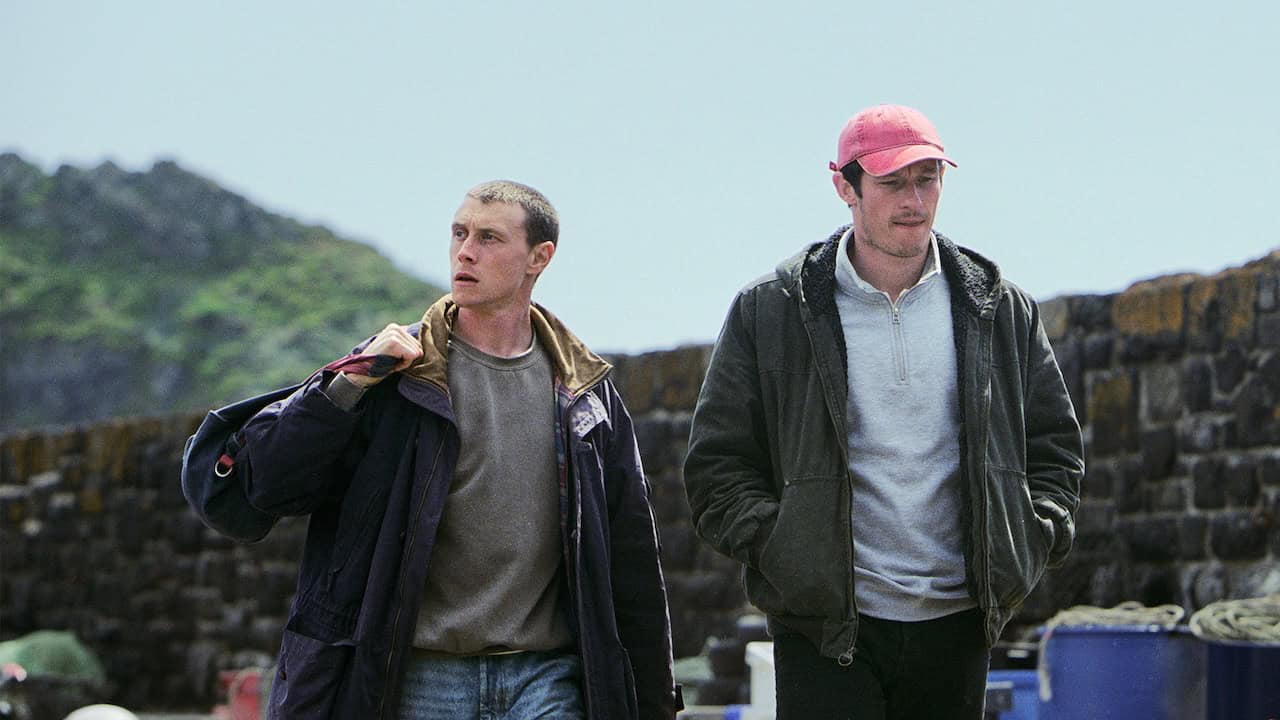
Upon arriving back home, the village appears to be more bustling. The once-dead pub is now alive with conversation, and smaller details, such as the architecture and the use of coins, feel different. Only when attempting to go home and being confronted by a much younger version of his neighbour (Mary Woodvine), who believes Nick to be her son now, does Nick realise the truth. Somehow, the boat has taken them back in time, to 1993, with Nick and Liam now being perceived as the crew members who went missing all those years ago.
The technicalities and circumstances for how this boat was able to time-travel are never explored, but they are not the purpose of the story. Instead, the film plays like a horror, not just in the panic of suddenly being cut off from all you know and love, but also in the contrast between the past and the present. Bait, and to a lesser extent Enys Men, was about the complications of community and the precarity they have undergone in the aftermath of rising inequality, worsening mental health and ridiculous political fiascos (namely Brexit).
Rose of Nevada is a particularly vocal call to bring back what once was. Before the age of overwhelming apathy we seem to feel today, emboldened by increased technology and the erosion of ethics in favour of fascist division, we had strong communities and a sense of purpose in our lives. Although the time travel component of the picture is horrific when one considers the implications, it’s nonetheless impossible not to notice how much bleaker the present is compared to this imperfect but fundamentally more connected past.
READ MORE: BFI LONDON FILM FESTIVAL
Jenkin’s on-hands approach and signature reliance on older cameras add to the thematic dimensions. Shot on 16mm film with a wind-up Bolex, similar to Bait before it, the film grain and choppy editing give the impression that it has been lifted from a distant dream. Sound, including dialogue, was added in post-production, the slightly off audio adding to that feeling of wandering through a dream or nightmare. That the opening scenes subtly serve as foreshadowing, without us even realising it, is a testament to Jenkin’s skill with non-linear storytelling.
There is a certain homeliness to the recreation of 90s British settings, as the mise-en-scène recreates the time period marvellously. Yet, as thriving as the Cornish community in these scenes clearly is, it doesn’t obfuscate the inherent horror of being stranded in an unknown time, disconnected from yourself and those around you. No one in the UK is making films quite like Jenkin, and the visual style alone showcases this in endless spades.
Jenkin relies on a small pool of trusted actors, and many of them do appear in this picture. Chief among them are Edward Rowe and Mary Woodvine, both of whom were brilliant as the leads of Bait and Enys Men, respectively. Yana Penrose plays a particularly haunting dual role that adds to the complications of the lads’ misadventure. Yet this film belongs to George MacKay and Callum Turner, more established actors who join the cast to help realise Jenkin’s ambitions. They work well within Jenkin’s confines, embracing the different paths their characters take as the story unfolds. Turner is the more rambunctious of the two, although he hides a certain vulnerability that influences his characters’ choices. Meanwhile, MacKay, possessing ever the volatile range, is devastating as his hope slowly but surely erodes, in contrast to the bustle around him.
Rose of Nevada does suffer from a longer runtime than Bait and Enys Men’s tight 90 minutes, meaning the pacing occasionally drags in places. Like Jenkin’s previous films, its tone and approach are so comfortable in its own skin that it may not entirely work for audiences not on board. But for those like this critic, who adore Jenkin’s unique approach, Rose of Nevada proves an engrossing and rewarding watch. An articulate rumination on the loss of tight-knit communities to modern precarity, to the tune of dazzling old-school filmmaking, Rose of Nevada often confuses but always mesmerises.
Rose of Nevada is screening at BFI London Film Festival and is awaiting a UK-wide release date.














Follow Us