
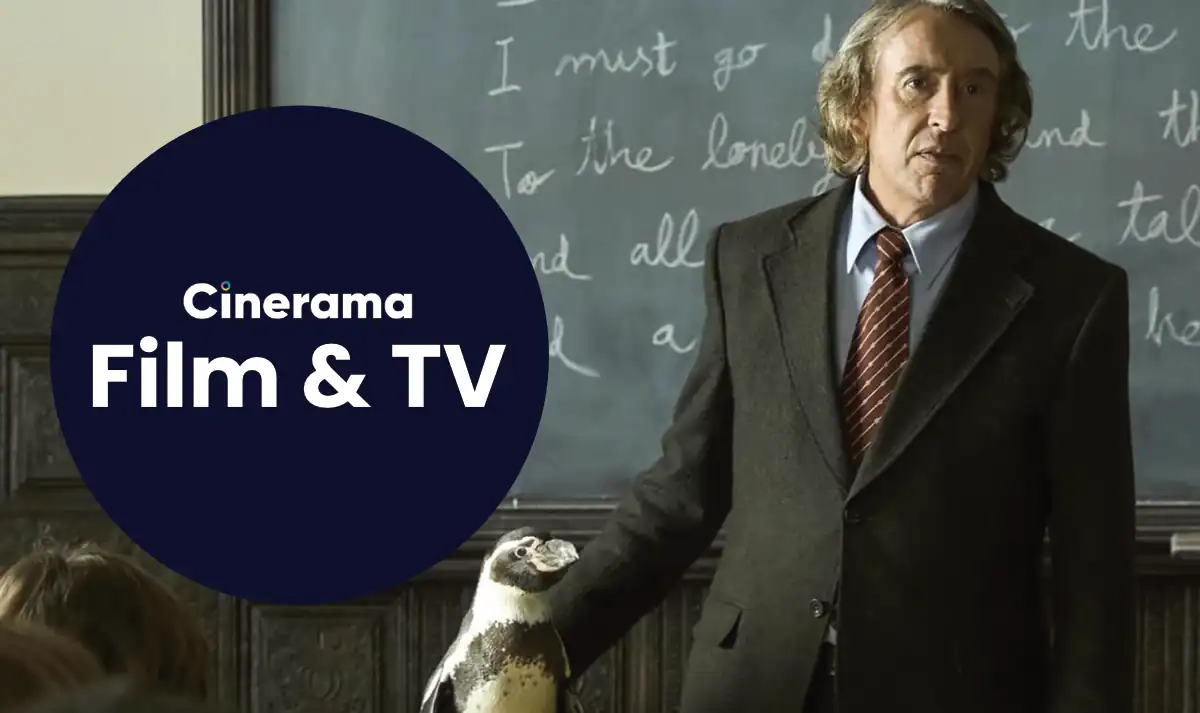
Peter Cattaneo’s The Penguin Lessons, starring Steve Coogan, is now showing in cinemas nationwide.
While watching Peter Cattaneo’s The Penguin Lessons, I was acutely reminded of 1989’s Dead Poets Society, and 2024’s I’m Still Here. Tonally and narratively, they are polar opposites, but The Penguin Lessons fuses their essences for its own end. Aesthetically, it’s very Dead Poets Society or “Dead Pets Society,” as my fellow critic Alistair Harkness quipped outside the press screening. Yet, thematically, it embodies the same principles of community and freedom in the face of political oppression as I’m Still Here does. This makes The Penguin Lessons a tonally uneven but ambitious and ultimately uplifting experience.
Based on the 2015 memoir of the same name, the film is set in 1976 Argentina, when the country was falling to a fascist military coup – not the words one expects to read about a cute penguin film. The cynical Tom Michell (Steve Coogan) arrives to teach English at an elite all-boys school. Disillusioned by his experiences in life, he recognises the injustice of the new fascist regime and the school’s indifference to it, but remains apolitical. Furthermore, his unruly students are as disinterested in his subject as he is in teaching them, leaving him in something of a career stalemate.
During a trip to Uruguay in which he sleazily tries to pick up a woman at a bar, Tom rescues a penguin beached by an oil spill. He cleans the penguin up and finds that it does not want to leave his side. As he eloquently puts it, “I ended up with no sex and a penguin”. Forced to bring the penguin back to the school with him, Tom is surprised to see his students and the school faculty responding well to the penguin, whom he names Juan Salvador. The popularity Juan Salvador amasses not only brightens the school, but forces Tom to confront his apolitical ways.
A more overtly political film than one may initially believe from its marketing, the film focuses on the use of metaphors to enhance its themes. In a classroom scene, Tom has his students learn metaphors through poetry – how objects and images can be used as stand-ins for deeper meanings. Juan Salvador, the penguin, is not just a mischievous new pet but a metaphor for freedom and activism. Tom’s flaw is his inability to take action, and so the mere act of adopting a penguin starts a chain reaction in which he gradually finds the courage to teach his apathetic students the benefits of freedom and, in his own way, stand up to the corruption outside the school walls.

This choice doesn’t always work – representing the need to liberate oneself from a fascist regime via a penguin metaphor is bizarre at best – but it’s nonetheless intriguing to see from a film of this calibre, which may have otherwise just stuck to light-hearted penguin antics. The film has the latter in abundance; a school cleaner and outspoken critic of the fascist government, Sofia (Alfonsina Carrocia), and her grandmother Maria (Vivian El Jaber) both take an instant liking to Juan Salvador, who wanders around the school with great curiosity. The scenes of Tom having to smuggle Juan Salvador around, only to give up and confess he has a penguin with him, are some of the most amusing, as Tom can only react with haplessness to the sheer insanity of his circumstances.
One can see the Dead Poets Society parallels instantly, as Tom starts bringing Juan Salvador into class so that his students may engage with him as he teaches them the importance of free thinking and free speech. But where Dead Poets Society was pretentious and artificial, The Penguin Lessons captures a sense of urgency to back up its sentiments. In the streets outside the school, various people “disappear” for speaking out of turn, which is where the similarities to I’m Still Here come in. Juan Salvador may just be a penguin who partakes in silly antics, but his presence encourages those around him to embrace change and thus incentivises people into action in order to change the status quo, most of all Tom, who finds himself facing his cynicism head-on, all because of a chance encounter with a penguin.
It’s really, really strange and it shouldn’t work at all… yet it just about does. Perhaps this is a case of chance timing, given the rise of a fascist regime in America at least, but the contrast between its two different tones, while jarring, does showcase the banality and cost of enabling oppressive politics. Wide shots are frequently used to capture the empty spaces around Tom at the start of the film, only for those same wide shots to be populated with people as the film progresses. It’s not subtle in the least, but it’s effective at conveying the sentiments of how embracing change and freedom makes one, as Tom describes in a lesson, “unvanquishable”.
At the heart of the film is Steve Coogan, whose smarmy style is a bit of an acquired taste. His sarcasm and cynicism are in abundance, as per the character, but the gradual opening up of his vulnerabilities makes the character a compelling one. That Coogan is able to improvise and adapt to the whims of his penguin co-host, who was genuine and not CGI, is a testament to his ability. His natural juggling of destabilising drama and comedy makes him a good fit for the story, able to just about harmonise the two contrasting tones despite some hiccups.
The unorthodox narrative and tonal whiplash of The Penguin Lessons make it an oddity. Nevertheless, the charismatic cast and the convictions of its sentiments make it an intriguing and ultimately life-affirming watch. If nothing else, the film is true to its penguin metaphor – it’s resilient and adaptable, traits that we may well find ourselves needing in the face of a changing industry and world.

















Follow Us