
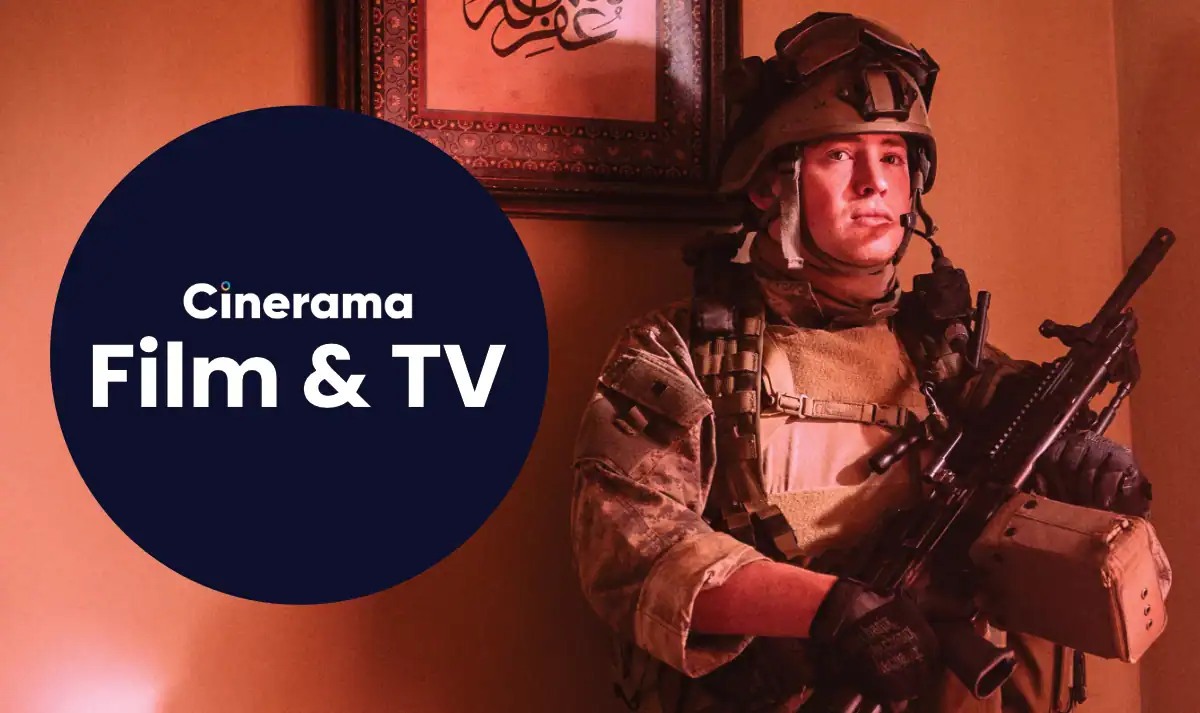

Ray Mendoza and Alex Garland’s Warfare, starring D’Pharaoh Woon-A-Tai, Will Poulter, Cosmo Jarvis, Kit Connor, Finn Bennett, Joseph Quinn and Charles Melton, is now showing in cinemas nationwide.
Although we have many testimonies to describe the realities of war, it’s a feeling that few can truly understand unless they’ve been in combat. This is a sentiment that Warfare fully appreciates. Co-directed by Alex Garland of Ex Machina and Ray Mendoza, an ex-Navy SEAL, the film depicts one battalion’s experiences in the Second Battle of Ramadi. Armed with the desire to replicate the experience of being in an active warzone, the result is stellar craft and uncompromising ferocity.
November 19th 2006: Navy Seal Team Alpha One is partaking in combat in Ramadi, Iraq. In the dark of the night, they storm and take control of a multistory home in the middle of the conflict. They round up the residents, including a family with two young children, take up positions and await further orders. Following the opening storming, these scenes have a disquieting authenticity. The troops sit and wait, frequently checking in with comms just to give them something to do.
But when a grenade is thrown into the building, causing an all-out battle to ensue against jihadists, the monotony is destroyed. Now on high alert and desperate to contact their military backup, Alpha One buckles down to return fire and survive until reinforcements arrive to evacuate them. But as the battle increases in intensity, injuries, trauma and uncertainty accumulate, with the viscerality of warfare on full display.
Warfare is a chamber piece with a top-rate ensemble cast, including Will Poulter, Joseph Quinn, Kit Connor and Cosmo Jarvis among others. D’Pharaoh Woon-A-Tai even plays a version of Ray Mendoza, who crafted the screenplay alongside Garland using both his memories and those of his fellow brothers-in-arms. Filmed in what appears to be one gigantic set piece – including both the house and the streets surrounding it – the film takes a page from Christopher Nolan’s Dunkirk in reflecting on the experience of war, although a story is present. The characterisation is largely arbitrary, except for them being soldiers in battle. Outside of Ray, most characters are simply known by their first names.
However, this is mitigated by the sheer intensity of the craftsmanship, which is designed to immerse you in the horrors of war. Many films have tried to replicate that singular feel since the iconic, unbeaten D-Day sequence in Saving Private Ryan, but few have done so as well as this film, whose capacity to overwhelm the senses by design is jaw-dropping. The tight framing of the cinematography induces claustrophobia, with the soldiers trapped like ants as reinforcements are delayed and the jihadists fire upon them relentlessly. But the sound design is what stands out most of all. The lack of a score grounds the action in a harrowing authenticity, with the audience given as much time to process and adapt as the soldiers are – a demonstration of sharp editing. In one of the film’s most horrifying sequences, an IED lands a devastating blow on the battalion, severely injuring one of the characters. The traditional ringing-in-the-ears effect plays, the sounds of war drowned out by the ringing as the character’s comrade drags him back into the house. On cutting to the house’s interior, the ringing is replaced by the blood-curdling screams of the injured man, which play throughout the film as if to make up for the void where a soundtrack should be. The agony and terror of this man is palpable, creating an atmosphere that’s nothing short of nail-biting.

Subtleties in the writing elevate the humanity of what we’re watching, even if we lose track of character names. The dialogue primarily starts as military jargon. But as the intensity is cranked up and the injuries start to amass, the soldiers begin to verbally slip, a swear of exasperation or a panicked sigh breaking up the jargon. By the crisis point, jargon is all but gone. It’s a small but delicate touch that reminds us that underneath the carnage are ordinary people.
That this philosophy is extended across the entire picture elevates this from an expertly assembled war film into a deeply resonant anti-war film. Warfare easily could’ve been another of those “Yay, American Patriotism” movies, which are routinely bland and self-indulgent if not outright tasteless. Yet we also get a handful of scenes from the Iraqi perspective, namely the terrified family whose home gets commandeered by the battalion. Even if the family survives the battle, they lack the armour and technology of the Americans – their home has been shot asunder. How are they possibly going to rebuild from that?
What this amounts to is a film that decries the effects of war on all parties involved. Soldiers are left with physical and mental scars, while innocent civilians are left with their lives ruined, be it through death, trauma or the destruction of their homes. The film doesn’t explore the broader context of the setting – namely, the illegal nature of the Iraq War – which would have elevated its themes all the more. But, given the inherent limitations of the chosen storytelling device, it does a sufficient job of lambasting the devastation of war while simultaneously highlighting the camaraderie that can be born between soldiers. It’s a film that engrosses you in its mastery of craft while giving you plenty of food for thought after the credits roll.
In February this year, my cousin passed away at 52 years old. He was a soldier who served in Afghanistan during the War on Terror. I wish I had spoken to him about his experiences more, as, whatever the geopolitical context, there’s an undeniable bravery to someone who goes to war. Watching Warfare reminded me of his courage and that of soldiers at large. It’s an unapologetically visceral watch, but one that achieves its desired effect with the power of a tank. Warfare isn’t easy viewing, but it is a masterfully assembled film that lingers in the mind long after the credits have rolled.














Follow Us