

David Ayer’s A Working Man, starring Jason Statham, is showing in cinemas nationwide from 28 March.
Movies like David Ayer’s A Working Man are arguably critic-proof. It’s a Jason Statham picture where he says a bunch of catchphrases while killing waves of goons, like a Call of Duty game. You know what you’re getting into. There are times when this formula has worked, and Statham is certainly a capable actor, whether in a gritty role like Snatch or in Spy, where he steals the show as a parody of himself. Sadly, A Working Man is too scattershot to be compelling and too undercooked to be entertaining.
Based on Chuck Dixon’s 2014 novel Levon’s Trade, Statham is Levon Cade, an ex-Royal Marines commando. Suffering from PTSD, he leads a quiet life as a construction worker for the wealthy Garcia family. Although he is working to regain custody of his young daughter, Merry (Isla Gie), who was taken in by Cade’s father-in-law after Merry’s mother committed suicide, Cade keeps his head down and works hard, earning him the respect of his boss, Joe Garcia (Michael Peña) and Joe’s spunky 19-year-old daughter, Jenny (Arianna Rivas).
While out partying with friends, Jenny is kidnapped by a syndicate of human traffickers. Aware of Cade’s military past, Joe asks him to locate Jenny and bring her home. Although initially reluctant due to his own capacity for violence, Cade is eventually on the case after a mandatory, emotionally hollow pep talk from his wartime buddy Gunny (David Harbour). Utilising his, say it with me, ‘very particular set of skills’, Cade races against the clock to locate and rescue Jenny, uncovering a grand conspiracy in the process.
Aside from parallels to 2008’s Taken, those who crave escapism may find some joy in the film’s premise as Statham mows down creepy traffickers, all while seemingly taking no damage. It’s a spectacle that’s preposterous but undeniably enjoyable when crafted correctly. The thematic lone-hero implications of the title are as subtle as a sledgehammer to the face, but there is perhaps some interesting commentary here on resilience and on embracing one’s past, as Cade accepts his PTSD rather than denying it. However, given that the PTSD angle is dropped by the midpoint, this observation feels like grasping at straws.
The script is penned by Ayer and Sylvester Stallone, the latter of whom arguably embodies the working-class hero story when you consider the against-the-odds success of Rocky. Sadly, Stallone settles for the most rote version of this narrative while strangely cramming it with so many characters and plot points that its two-hour runtime feels even longer. The supporting cast includes David Harbour, Jason Flemyng, and Michael Peña, yet they are collectively in so little of the picture that giving them such high billing feels like false advertising. Every plot beat and every character’s motivation are so predictable that the stakes lack gravity. Even a scene of a character flipping something off can be seen coming from a mile away.
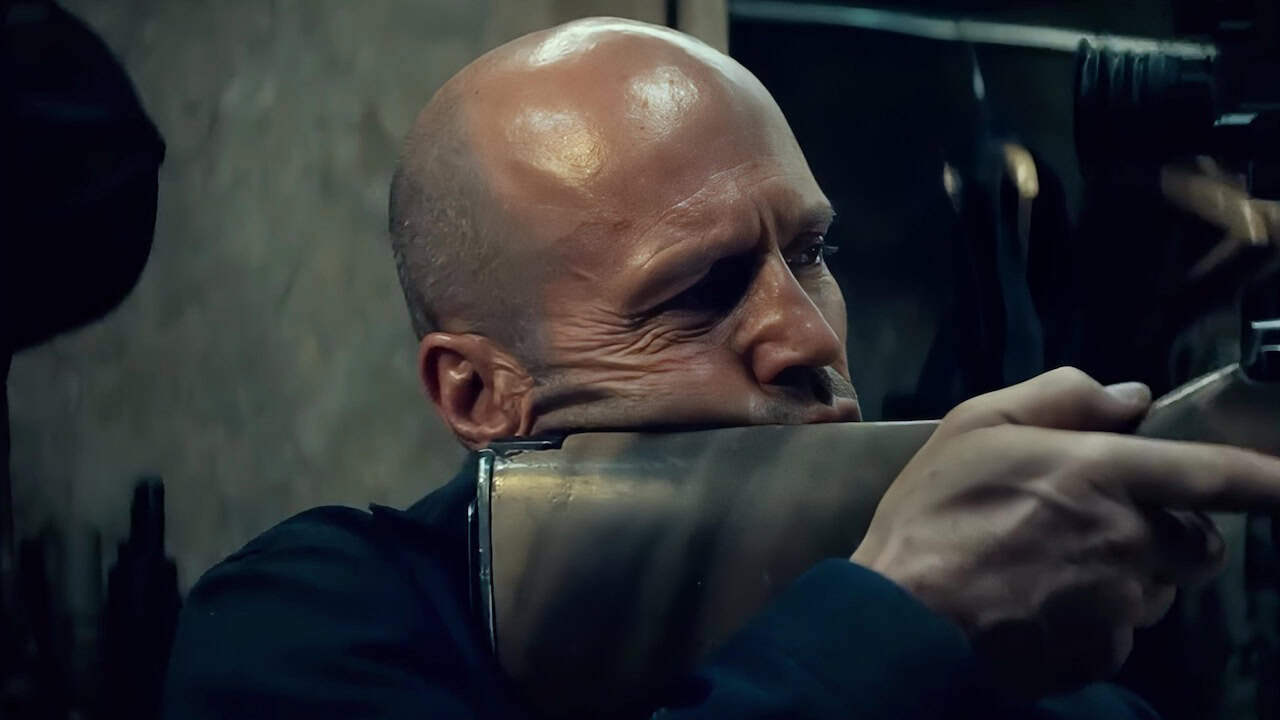
Cade, who starts off fairly interesting with his PTSD flaw, is quickly reduced to a generic action-hero persona. His abundance of typically masculine traits makes him boring, while his lack of vulnerability shows a misunderstanding of the action genre, as it’s the character’s vulnerability that makes action films like Speed or Die Hard so engrossing. The film proclaims the necessity of defending people, particularly family, through Cade’s flat arc, while weirdly still treating women as commodities who need to be safeguarded by men, making any speech Cade makes about protecting daughters an unmistakable cringe. Although it’s only half as embarrassing as the villainous characters, many of whom are caricaturistic to the point of being cartoonish.
Frustratingly, the filmmaking isn’t sufficient to support its action. Where Novocaine, also releasing this week, had the camera follow its hero as he was beaten around like a punching bag, A Working Man relies on an unhealthy amount of close-ups on faces as they square off, making the surrounding fisticuffs and gun battles challenging to discern. Not helping is the sheer erratic editing, with smash cuts used so often that some shots must last mere nanoseconds. Perhaps this is for the best, though, as some of the action we can see is ridiculous to the point of disbelief.
In one sequence, Cade is riding a motorbike while being pursued by gunmen in vans. They fire a hail of bullets at his exposed back, yet the bullets bounce off of both the bike and Cade himself as if he were made of titanium. These moments of baffling implausibility should be cherished as the incredulous laughter they generate is one of the few emotional responses the film genuinely earns.
We’re left with a dull, shallow experience, albeit not without its merits. Arianna Rivas demonstrates wit and toughness despite her damsel-in-distress role. This includes a scene in a forest in which the character displays admirable resilience, despite its redundant narrative function. There’s the odd touching moment between Cade and his daughter, and a couple of the kills – one involving a swimming pool- hold some morbid creativity. But they aren’t enough to save the film from its pedestrian story and themes, bland characters, and messy action spectacle.
It’s unwise to the point of delusion to expect Casablanca out of movies like A Working Man, but at least a shade more depth and a lot less boredom would have been appreciated. Sloppy presentation and a by-the-numbers narrative make the film a flavourless experience that’s severely lacking in entertainment. Despite blatant foreshadowing of a potential sequel, the story offers no real conclusion, never wrapping up the broader implications of the conspiracy Cade uncovers. It just runs out of steam and stops. This won’t really matter to those who simply want to see Jason Statham punch people – in itself, an understandable desire. However, those craving more substance and a much better spectacle in their action films should stick with The Raid or John Wick.















Follow Us