

With a more polished script, this could’ve been a sports comedy on par with a classic like Cool Runnings. But Waititi needs to dig deeper if he wants to recapture the signature charm of his early career, as seen in Boy, What We Do in the Shadows or Hunt for the Wilderpeople. Next Goal Wins arrives in cinemas nationwide on December 26th.
What happened to Taika Waititi? Following his transition from playful New Zealand Indies to 2017’s Hollywood hit Thor: Ragnarok, his idiosyncratic humour once seemed primed to take over the cinematic world. Such attributes won him a Best Adapted Screenplay Oscar for Jojo Rabbit (although it should’ve gone to Greta Gerwig for Little Women). But he’s since struggled to recapture the charm of his earlier films, turning in subpar writing and directorial efforts with Thor: Love and Thunder and, frankly, insufferable acting in Free Guy. Next Goal Wins is sadly not a return to form; instead, it seems like the lineman is still waving offside in this career slump.
A comedy-biopic based on the 2014 documentary of the same name, we are introduced to the American Samoan football team as they are resoundingly crushed 31-0 in their qualifier match for the 2002 World Cup. As a Scotsman, I can relate to such football-based losses. Ten years later, a new opportunity arises. Thomas Rongen (Michael Fassbender), an aggressive down-on-his-luck coach, is given the impossible task of turning this appalling team into a squad capable of scoring a goal, never mind winning a match. But, faced with cultural differences, undisciplined players, and an undisclosed traumatic past, Thomas is facing an uphill battle.
This is an appealing premise. Everyone likes an underdog story, and Waititi, to his credit, does glean interesting thematic resonance through this setup. Football – or soccer, depending on your country – can get especially heated, whether through the intense plays or the cult-like hooliganism of some fans. It’s easy to forget that it’s just a game and that having fun is more important than victory. The American Samoan team depicted here know that they’re bad at football. Still, they’re just happy to be playing, displaying no interest in the glory or riches that overpaid Premier League teams seem to crave more than the thrill of the game. In a sense, they embody the football spirit better than any of those teams. This anti-elitist stance shows that the film’s heart was in the right place.
Unfortunately, the script from Waititi and co-writer Iain Morris has a supremely irritating habit of undercutting the earnestness of these sentiments. The very first frame sees Waititi donning a bizarre priest costume, complete with a handlebar moustache and buck teeth, breaking the fourth wall to recount the team’s humiliating incompetence. The joke seems to be purely about how weird he looks, but the obnoxiousness is far from over.
During a pep talk in the changing room, the previous coach, Ace (David Fane), spends three lines talking about needing to grill his team, only to politely describe their performance as poor. Similar to Waititi’s priest speech, the script spells out the joke in painful detail, as if it’s afraid viewers aren’t smart enough to understand irony or punchlines. One scene, in which Rongen protests a job loss, features a projectionist replacing slides with words detailing each stage of grief after his boss (Will Arnett) exclaims that Rongen is going through the five stages of grief. With such steadfast faith in audiences, it’s a wonder the film didn’t include a laugh track.
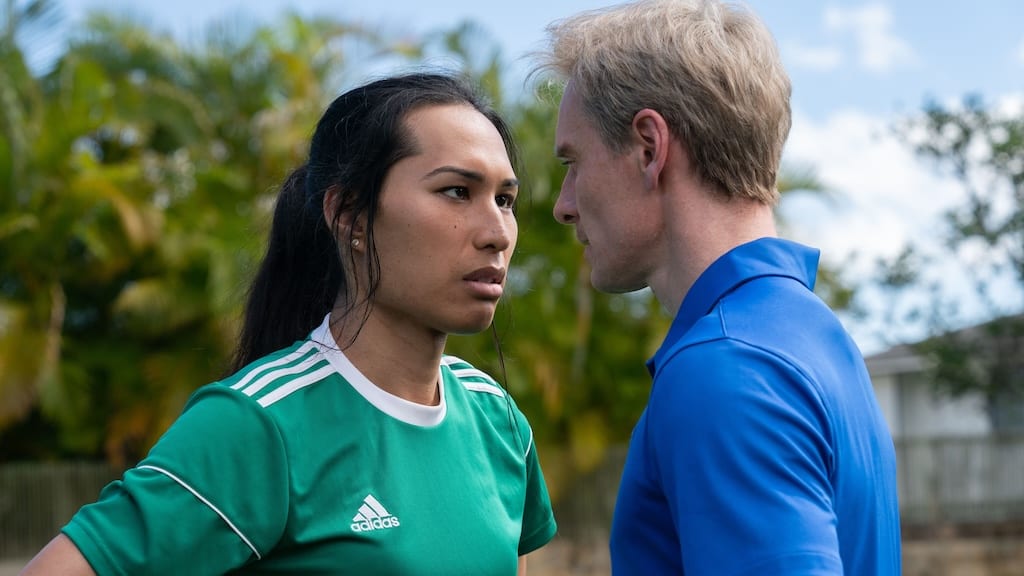

Understanding that it’s a comedy isn’t enough, as the immaturity of this humour, especially when contrasted with the film’s good-natured themes, undermines whatever honesty it aims to showcase. The technical choices, from the violin scores that emphasise how saccharine the visuals may be to the overreliance on tonally jarring smash cuts, all add to the sense of insincerity that its addiction to cartoonish humour embodies.
Stories like this often have a predictable beginning, middle and end, but this is easily forgiven with the right amount of heart and charm. But because heart and charm are so inconsistent in Next Goal Wins, its story feels safe at best and stale at worst. That it all seems filtered through Rongen’s flippant unhappiness creates a feeling of disingenuousness, with the comedy threatening to turn into a mockery of, rather than an endorsement of, American Samoan customs.
One of the better characters is Jaiyah (Kaimana), a fa’afafine player (Polynesian for third-gender people, e.g., transgender or non-binary). Incidentally, she’s the first openly transgender athlete to compete in a World Cup qualifier. It’s refreshing to see her inclusion and how valued she is amongst her teammates and community. Kaimana delivers a great performance, channelling their role with vulnerability and gravitas alike, while their character’s struggle with leadership proves quite compelling. However, their role comes dangerously close to purely serving Rongen’s redemption arc, whose instance of deadnaming Jaiyah feels poorly conceived. This is primarily due to Rongen’s lack of accountability beyond a weak apology, which adds to the film’s feeling of inauthenticity. That Rongen’s own redemption arc is formulaic and lacking in urgency, outside of the emotional reveal, which Fassbender does a strong job of, continues to contribute to the film’s exuding disappointment despite its best intentions.
With a more polished script, this could’ve been a sports comedy on par with a classic like Cool Runnings. But Waititi needs to dig deeper if he wants to recapture the signature charm of his early career, as seen in Boy, What We Do in the Shadows or Hunt for the Wilderpeople. Next Goal Wins has moments of sweetness, but it’s more interested in overwhelming audiences with poorly thought-out jokes than in celebrating the sport, the characters, or the themes it depicts. The result is generic, patronising, and more irksome than funny. The 2014 documentary is fascinating and deserves a watch, but if moviemaking were a football match, Waititi would get a yellow card.















Follow Us