

As the creative, bold and compelling Robert Icke adaptation of Romeo & Juliet opens at the Harold Pinter Theatre, starring Noah Jupe and Sadie Sink, Jane Jung explores the endlessly reimagined Shakespeare classic.
How many times has Shakespeare’s Romeo & Juliet been staged? Among Shakespeare’s works, few hold such singular recognition. Often described as the world’s most famous love story, its legacy extends far beyond the original play: into opera, ballet, film, and even musicals like West Side Story, which drew directly from its narrative.
In London alone, I’ve encountered multiple productions over the past three years. In May 2024, Tom Holland starred as Romeo in a widely discussed production directed by Jamie Lloyd. The previous summer, in August 2023, Matthew Bourne reimagined the story through a contemporary lens, reshaping it with bold choreography. Just one month earlier, in July, Rebecca Frecknall filled the Almeida Theatre with candlelight, creating a version that was both intimate and intense. There was also an open-air, touring production staged in St. Paul’s church garden on a summer evening. Shakespeare’s Romeo & Juliet is a work that never stops being remade.
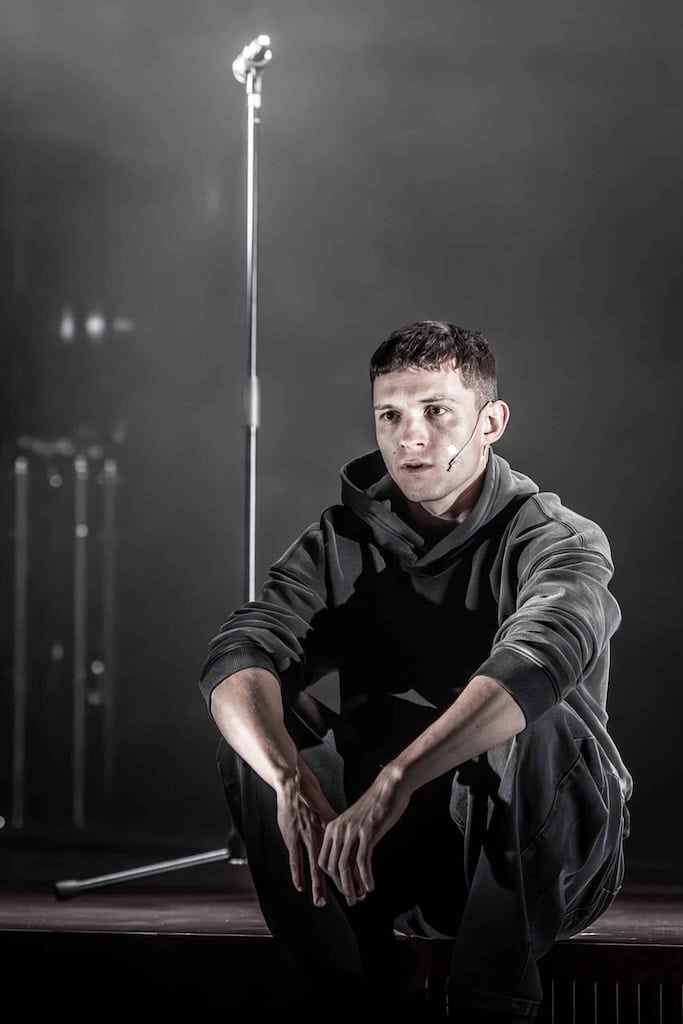

Romeo & Juliet ©️The Jamie Lloyd Co.
Also playing at Shakespeare’s Globe is a new staging of the play for younger audiences, with the historic wooden theatre covered in graffiti and bicycle stunts woven into the action, creating a distinctly contemporary energy. Condensed to 90 minutes and underscored by percussive rhythms, the production becomes more immediate, physical, and accessible. What stands out most is how closely the staging of this production mirrors scenes from present-day London.
Banished, Romeo unrolls a sleeping bag and spends the night on the street like someone made homeless. In Shakespeare’s original, fate turns on a letter that was never delivered. Yet, here, Romeo misses a crucial message after a passing cyclist snatches his phone. After the fight, Mercutio lies motionless on the ground as others leap over his body on bicycles, pulling out their phones to take photos. Some even flash V-signs for the camera, turning a moment of death into something to be consumed. It is an unsettling image that reflects a reality we would rather look away from.

Romeo and Juliet ©️Shakespeare’s Globe
This disturbing sequence becomes the turning point of the play. Romeo, who had already married Juliet and sought to avoid further conflict, is provoked into stabbing Tybalt after witnessing his friends mock the death of Mercutio. The precarious bicycle stunts echo the impulsiveness of youth – falling in love without calculation, without hesitation. And in a final, compressed image that gathers all the deaths into a single frame, the production makes clear that, however swiftly the story unfolds, it remains a tragedy.
Equally creative, bold and compelling is Robert Icke’s Romeo & Juliet, now playing at the Harold Pinter Theatre. Framed by Juliet’s line, “In a minute there are many days.” This production approaches the play from an entirely new angle. I’ve seen countless versions of Romeo & Juliet, but this is the first time an adaptation has moved me to tears.
The production stars Sadie Sink and Noah Jupe – both making their West End debuts, with Jupe appearing on stage for the first time. Having begun their careers as child actors, the two bring a striking immediacy to the roles, creating a version of Romeo & Juliet that feels unmistakably young. Their presence alone was enough to anchor the production’s publicity – and once seen, it’s easy to understand why.
Icke, often described as one of the most compelling voices in contemporary British theatre, previously left a strong impression with his politically charged reworking of Oedipus in the West End. There, a digital clock placed centre stage made time itself impossible to ignore. A similar device appears in this production of Romeo & Juliet. Two large panels move across the stage, intersecting and separating. At times they run forward, at others backwards, displaying the day, hour, minute, and second. Time is no longer an abstract force. It is made visible, measurable, and inescapable.
The most striking device, however, is the use of cinematic rewinds. A sudden flash of light, bright enough to leave an afterimage, resets the scene. As if memory itself has been altered, events begin again, but differently. It conveys the reality that, had events unfolded a fraction of a second sooner or later, the story might have unfolded in an entirely different way. What this production captures is the fragile threshold between life and death, where everything hinges on timing. Tragedy, it suggests, is not inevitable. It is shaped in the smallest, most accidental of moments.
This is not Robert Icke’s first production of Romeo and Juliet. His 2012 staging at the Nuffield Theatre in Southampton was widely praised for its vivid portrayal of teenage desire. In this new production, Juliet, newly in love, runs and leaps with her hair loose, unable to contain her joy. Romeo, eager to impress, tries to appear confident, yet something in him remains awkward and unfinished. Rosaline, who consumed him only moments before, is instantly forgotten the moment he meets Juliet. A shift that captures the intensity and volatility of adolescent feeling.

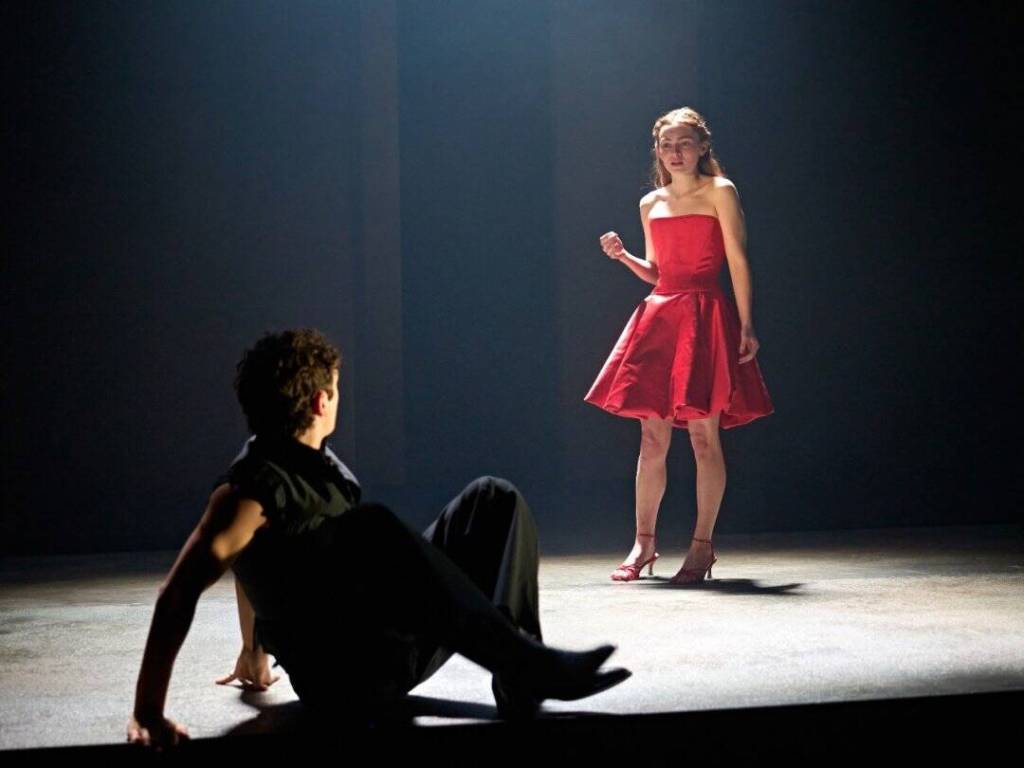
These characters do not build emotion gradually: they fall into it all at once. In this interpretation, Mercutio is both comic and abrasive. His crude jokes and provocative behaviour invite both laughter and discomfort. Even after being stabbed by Tybalt, he continues to joke, dismissing the wound as trivial, until the reality of his death becomes undeniable. In that moment, humour gives way to bitterness, and he dies hurling blame and curses at Romeo.
Juliet’s father initially appears warm, even affectionate. But the shift in tone is sudden. His tenderness hardens into violence, culminating in an unsettling display of control that extends even to striking the Nurse. When the Nurse, in turn, urges Juliet to accept a socially acceptable marriage, Juliet is left with nowhere to turn. By the final scene, her decision no longer feels impulsive, but inevitable.
In this new 2026 production, Icke reshapes Romeo & Juliet through casting and interpretation, allowing it to exist fully in the present tense. He does not simply restage Shakespeare; he reanimates it. By visualising how the smallest misalignments of time can alter everything, the production reframes the tragedy – not as destiny, but as the result of a single, fleeting divergence. Seen in this light, the present we inhabit is no different: a life arrived at through countless missed and met moments, each one shifting the course of what follows.
Romeo & Juliet is now playing at the Harold Pinter Theatre. Book Tickets.









Follow Us