
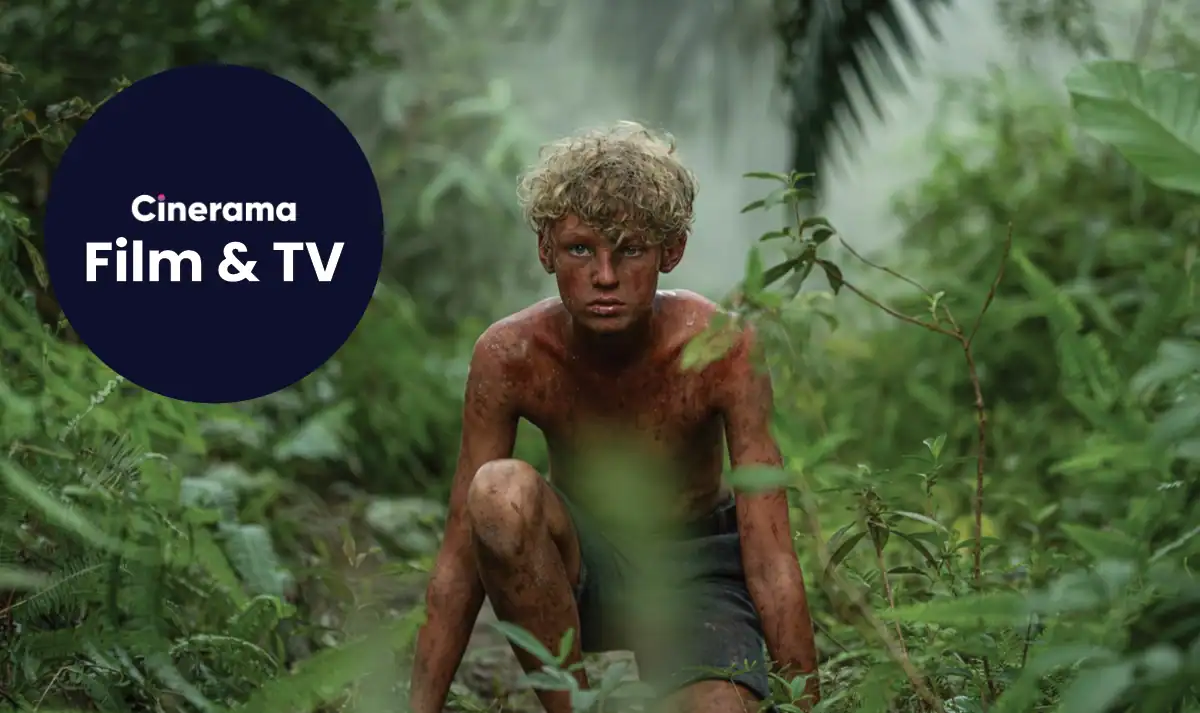

In its first television adaptation, Lord of the Flies, starring David McKenna (Piggy), Winston Sawyers (Ralph), Lox Pratt (Jack), and Ike Talbut as Simon, is written by Jack Thorne, directed by Marc Munden, and produced by Eleven. Watch Lord of the Flies on BBC iPlayer and BBC One from Sunday 8 February.
Lord of the Flies is the story of schoolboys stranded on a tropical island with no adults, following a deadly plane crash. In an attempt to remain civil, they organise themselves, led by Ralph (Winston Sawyers) and supported by the group’s intellectual, Piggy (David McKenna). But when Jack (Lox Pratt) becomes more interested in hunting and vying for leadership, he soon begins to draw other boys away from the group and, ultimately, from hope to tragedy.
The cast, many making their professional acting debuts, were auditioned after an open casting call, with no prior experience required. The process was led by multi-award-winning casting director Nina Gold (The Power of the Dog).
Original music for the series has been created by three of the biggest and most celebrated artists: composer Cristobal Tapia de Veer (The White Lotus) created the score, and Hans Zimmer (Dune), alongside Kara Talve (Prehistoric Planet), created the series’ main theme and additional music.
Commissioned by Lindsay Salt, Director of BBC Drama, Lord of the Flies is an Eleven and One Shoe Films production backed by Sony Pictures Television for BBC iPlayer, BBC One and Stan. The executive producers are Joel Wilson and Jamie Campbell for Eleven, Jack Thorne for One Shoe Films, Marc Munden, Nawfal Faizullah for the BBC, and Cailah Scobie for Stan.
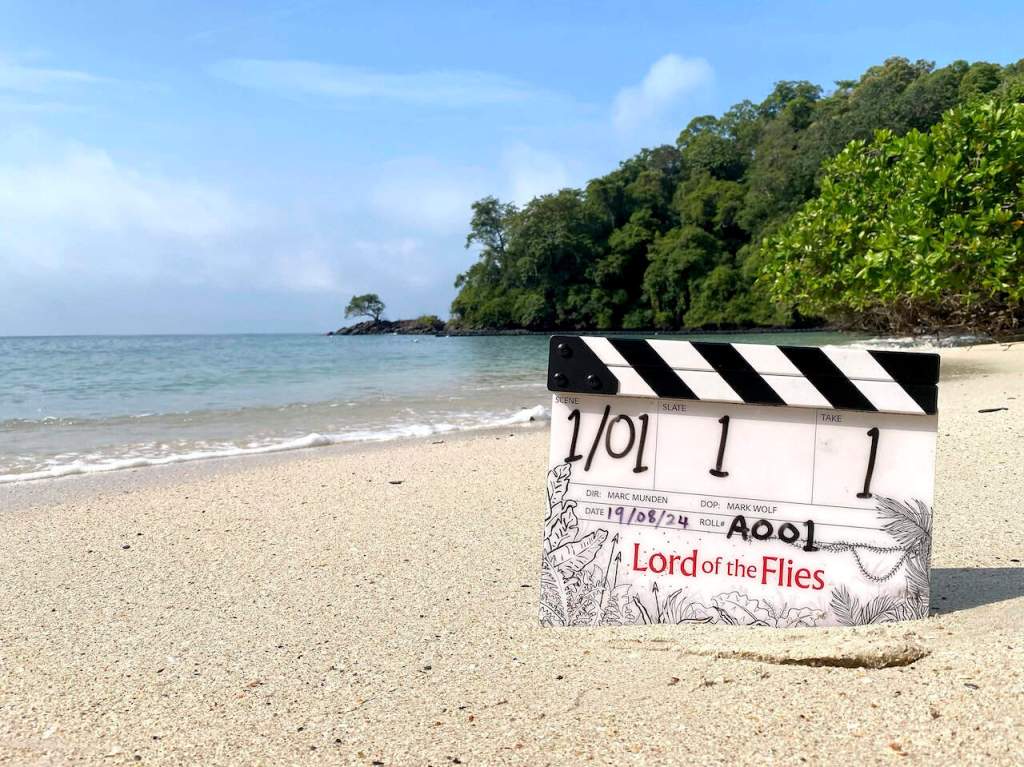
©️ BBC/Eleven/Callum Devrell-Cameron.
Q: What drew you to this story?
Jack – It’s something that I’ve always wanted to do. When we pitched it to the William Golding estate, it was very much a four-parter, written like a relay race. Finding that structure of telling the story via Piggy, then Jack, Simon, and Ralph. There was a very easy transition from book to screen because of that structure.
I think, as a society, we’re having a conversation right now about boys. We’re losing a generation of boys, and we’re losing it because of the hate they are ingesting – because it is an answer to their loneliness and isolation. The interesting thing about Lord of the Flies is that, I think, it’s a really loving portrait of boys. When I read it as an adult, I thought of it as a tender portrait of many very complicated boys navigating their status and anger.
It’s the perfect distillation of our contemporary problem, I think, in terms of looking at the male condition.
Lox – I think it represents a lot about boyhood and how a lot of boys just want to have fun. When the rules aren’t there, they will push the limits because there’s constant alpha-male strutting among all the boys. It’s different for everybody, but I think it’s a lot about the way that boys and humans work, and just boyhood in general.
Q: Were there challenges in adapting this classic story?
Jack – There were moments where I needed to sketch in a story, and trying to do that in a way which felt like Golding was sometimes very hard. But truthfully, it was a joy, because I knew the book so well. As someone who adapts, so much of your job is to have ingested the book and be able to feel your way around it. With Lord of the Flies, I knew where I needed to be, and that’s because I’ve been reading the book since I was 11 years old, so I’ve been reading it for 35 years. It’s a different relationship to any other book that I’ve adapted. Hopefully, in this adaptation, people will understand that the book’s complexity is far greater than they usually give it credit for.
Q: Winston, can you tell us about your character, Ralph and his journey in the story?
Winston – I think he’s quite charming, humble, and a little bit goofy at times. He’s the protagonist and quite a nice character; he gets along with most people. A lot, but not all. He leads the group of boys. I think Ralph symbolises justice, I guess. Ralph almost sacrifices himself in the name of justice because he knows what’s right. He sees what happens when he doesn’t intervene; they go to the other camp and join Jack for a little while, then he sees bad things happen. He’s very consistent in who he is and what he believes in.
Ralph starts off pretty good, nice, kind – he’s a leader. And then, as the story goes on, he loses friends and loses people in his camp. I think he still stays with the same agenda; he doesn’t want to join the bad guys. Ralph is quite rooted in who he is and what he believes in. At the end of the story, he’s traumatised, beaten, bruised, and he’s essentially just broken – but he survives.
Q: David, can you tell us about Piggy?
David – Piggy is the voice of reason within the group. He is, I would say, the responsible one who wants to keep everything calm and have rules. A lot of the boys go feral when they get stranded on the island. They just want to run around, hunt, kill and make food. Piggy’s the one who tells everyone we have to follow the rules and stay calm. It doesn’t end well for him, though, because the boys don’t react well to that.
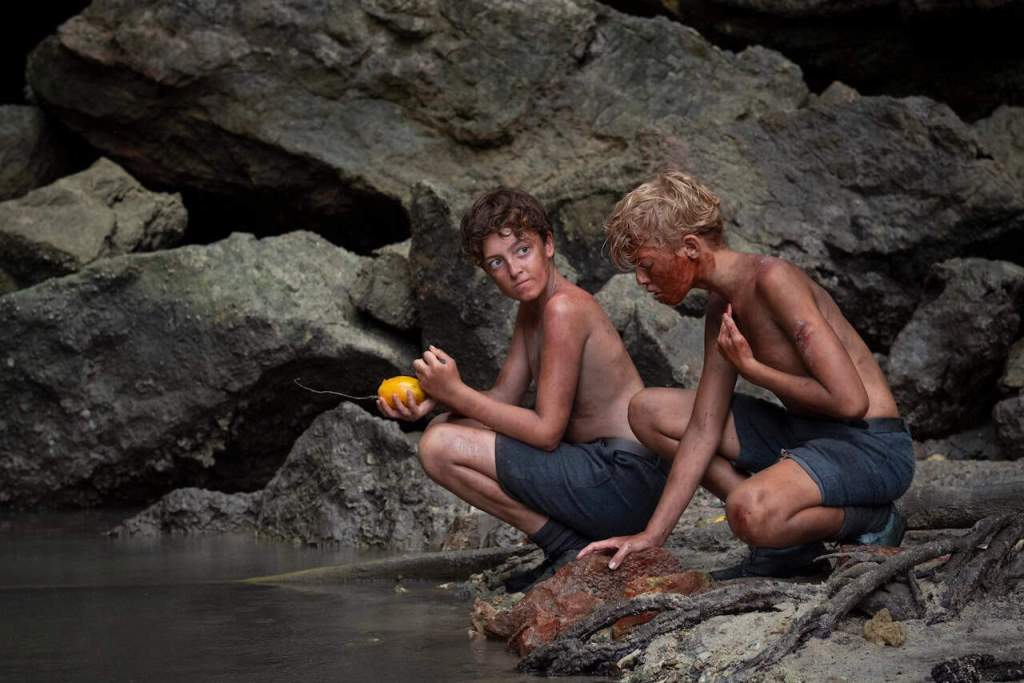
©️ (l-r) Ike Talbut as Simon, and Lox Pratt as Jack. BBC/Eleven/J Redza.
Q: And Lox, can you tell us about Jack? What did you like about the character, and what did you find more challenging?
Lox – I think my character is just completely taking charge of the situation because that’s just what he does. He is directing Piggy quite a lot because I don’t think he has much respect for him in any scene. But I really enjoyed playing Jack because he’s kind of unpredictable.
I think he had a lot of rough edges and a very tricky background. He’s very narcissistic, arrogant, and condescending, and he knows that he’s the best at everything. Deep down, he’s quite a scared little guy. He lashes out quite easily. Those are all quite hard but also quite fun to play. It’s fun to be able to do that and know that you’re not actually hurting anyone, and know that you’re not going to get told off afterwards. I found that quite tricky, but it was totally fine in the end, and I had a lot of fun. I’m very, very happy that I got to do it.
Q: What’s the relationship like between Ralph, Piggy and Jack?
Winston – Ralph and Piggy are really good together. They’re the perfect combo because Piggy has all the brains and all the ideas, and Ralph has the leadership skills. Ralph is like a vessel for Piggy’s ideas, thoughts and contributions. They work together, like really good friends.
Ralph and Jack have quite an interesting relationship. At first, they’re both leaders, and they work together in some ways. Eventually, they fall apart because they’re both alphas. Jack has his beliefs and ideology, and Ralph has different ones. They start as friends, but they realise that they’re kind of a threat to each other, like for power. And obviously, at the end, they absolutely hate each other. I think Jack hates Ralph more than Ralph hates Jack. They’re quite similar, but I think Jack is more aggressive. It’s like a love-hate relationship; they get along a little, but not enough.
David – I think it’s a complicated friendship between Ralph and Piggy. At the beginning of the story, when they first meet, Piggy admits to Ralph that the bullies at school always called him Piggy. Ralph promises not to tell, but he ends up telling everyone anyway. At the beginning, Piggy is a bit ‘off’ with Ralph, but as the story continues, they go through a lot together, and they really become close.
Piggy’s relationship with Jack is not good from the beginning. Jack meets Piggy and immediately judges him and starts picking on him. I don’t know if Jack’s doing this intentionally, but he would try to be friends with Ralph, knowing that Ralph is Piggy’s only thread to hold on to, and then Jack would just really go against Piggy. Jack ends up ordering for Piggy to be killed – sorry, spoiler alert! They don’t like each other.
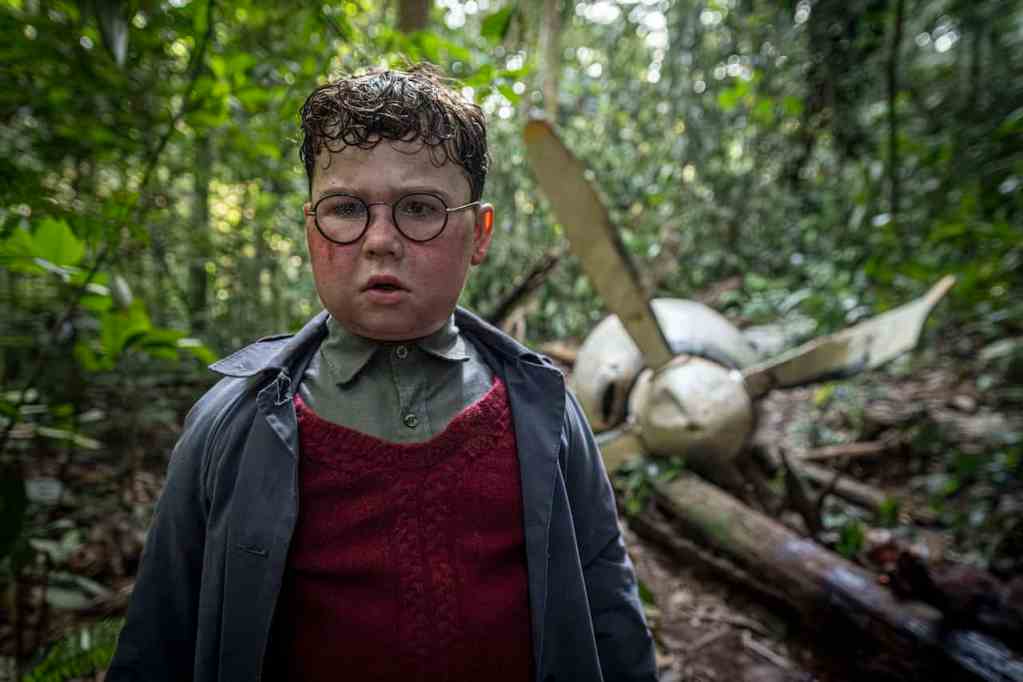
©️David McKenna as Piggy. BBC/Eleven/J Redza.
Q: What was it like filming in a tropical location? Was there a daily routine you slipped into?
Winston – I loved Malaysia. I loved my beach – I guess Ralph’s beach – in Langkawi. It’s so nice because it was such an open space. I feel like it’s completely different to a regular film, I used to think ‘how could anyone ever act on a set?’, because often it’s all green screen. I know it’s acting, I know you have to imagine things, but at the same time, I prefer having real things there. So Lord of the Flies was a great experience because everything felt real. You feel the breeze, hear the birds, and the insects, which are super loud as well. I think it made everything feel more real overall, and that really helped me get into the scene.
David – On a typical day, we would get picked up from the hotel in the van with our chaperones and drive to the resort world, where production was set up. When we got there, we’d put on our costumes and the makeup. We would get on a boat that would take us to a beach, kind of like an island. We would shoot, then go back to the hotel and do it all again the next day.
Q: What do you hope viewers will take away from the series?
Jack – I think Golding’s brilliance and complexity are often dismissed. “It’s all gone, Lord of the Flies” is used as shorthand for the most obnoxious things. I hope it takes people back to the book, and I hope it allows them to lean into what, in my opinion, the book really is: a difficult and dangerous account of who we are and what we’re capable of.
David – I would like the audience to take away from Lord of the Flies that you can work together. I feel like that’s what Piggy would say as well. It can work out if people just listen – and listen to everyone’s ideas rather than that one person who everyone idolises. In the case of Lord of the Flies, that’s Jack. Everyone idolises him because he is smart and he’s a leader. Whereas, if we had listened to everyone, it could have all worked out fine.
Lox – When I was chatting to Marc Munden (Director and Executive Producer) in rehearsals, he wanted the audience to see that the world is full of Jacks, and that things don’t work if there are just Ralphs. Ralph is interesting because he’s a good leader who prioritises the right things, whereas Jack doesn’t, but he’s also exciting. People think Jack is more exciting than Ralph, and that’s why everyone goes to Jack eventually. I think that people don’t go to the side that’s necessarily doing the right thing, but they go to the side that’s going to give them a bit more excitement.
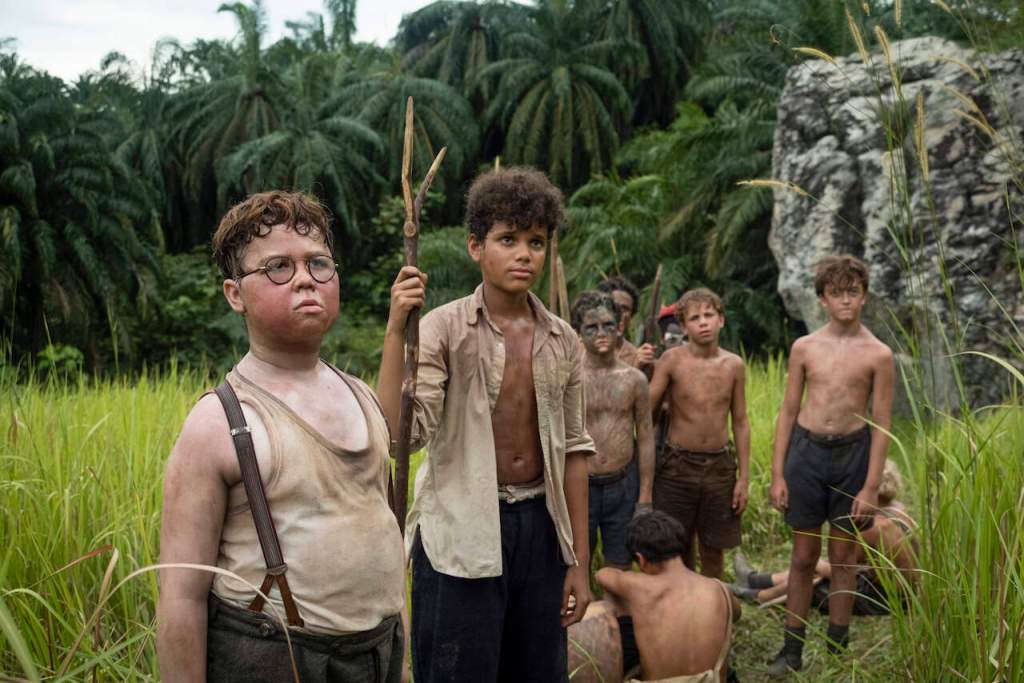
©️David McKenna as Piggy and Winston Sawyers as Ralph. BBC/Eleven/J Redza.
Q: Jack, do you think someone who has read the book will take away something different from this TV adaptation?
Jack – I think that’s the whole point of adaptation, so I hope so. There is joy in seeing a person breathe and think as a character, and these young actors are sensational and so committed to the parts they play. In terms of what I did, it is faithful, I think, to what he wrote, and I think Judy and the estate regard it as faithful too. It’s not full of dialogue; it’s very spare, and the dialogue used is a mixture of what Golding wrote and what I thought he might and where my instincts took me.
When Jack and Simon talk, everything they say comes from clues in the book, but it’s an extrapolation that is probably influenced by me, too. Where I felt myself pushing in too much, I pulled back. I didn’t want to hear the voices in my head, so I tried to bring out the voices in his. I hope I’ve kept his magic; it’s been an enormous honour to have been given this opportunity.
Watch Lord of the Flies on BBC iPlayer and BBC One from Sunday 8 February. Lord of the Flies is also screening at Berlinale 2026.









Follow Us