


Whether this will win Chalamet that elusive Best Actor Oscar remains to be seen, but, as a follow-up to Uncut Gems and its own modern sports drama, Marty Supreme is a nail-biting and thought-provoking kill shot.
Josh Safdie’s last directorial effort (co-directed with his brother Benny) was the hair-raising Uncut Gems. Not only did it give us Adam Sandler’s greatest performance (a film he should have won an Oscar for, yet wasn’t even nominated for), but it also demonstrated the Safdies’ skill in building tension and drama through intimate, reckless character decisions. That same talent is omnipresent in Josh’s new, solo-directed feature, Marty Supreme. Electrically paced and acted, it pursues its tagline “Dream Big” relentlessly, all while the film, basking in the thrilling tropes of underdog sports movies, showcases the moral grey area that drives and undermines the pursuit of success.
Loosely based on the life of Marty Reisman, this story is fictional. The picture is set in 1952, and Marty Mauser (Timothée Chalamet) is an aspiring Table Tennis (Ping Pong) champion. In between work as a shoe salesman for his uncle’s shop, this hotheaded 23-year-old New Yorker takes part in various competitions, dominating the stage and showing off where possible. In his mind, he’s already going to win the upcoming British Open and put Table Tennis on the map as a serious sport in America. As such, he treats his expensive accommodation and those around him as beneath him.
However, he is resoundingly humiliated in the finals, and thus Marty’s abrasive attitude comes back to bite him. Suddenly broke, jobless, and with hefty fines to pay, Marty decides his only chance at a comeback is in a proposed exhibition match in Tokyo against Koto Endo (Koto Kawaguchi), the Japanese champion, and the man who crushed him last time. His efforts to raise the money for the trip cause Marty and his pregnant partner, Rachel (Odessa A’zion), to go through hell and back, with bleak, funny, and enlightening results.
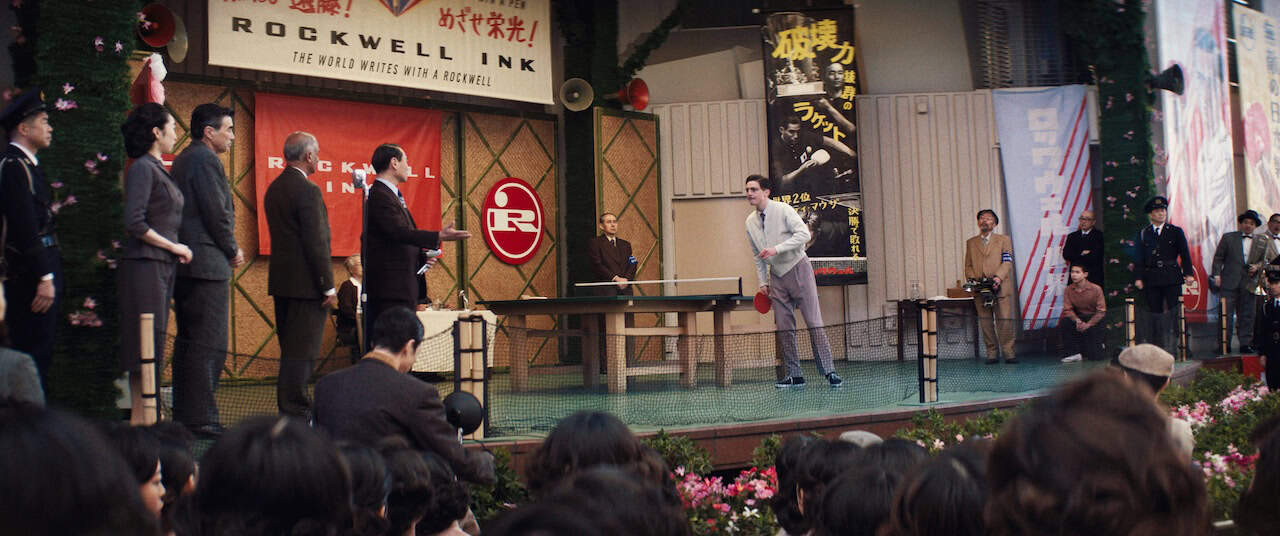
Legendary production designer Jack Fisk and team go to great lengths to recreate a ’50s aesthetic. A breeding ground for American Dream storylines, the muted colour palettes of the buildings and the crowded interiors of various offices, workspaces and sports grounds (one of the film’s best scenes is in a gorgeously remade bowling alley) create an energised world. A bustling, thriving community in marked contrast to Marty, who desires stardom but keeps getting in his own way as he travels down the path of greatness. The authenticity of the sets, costumes, and props lends a sense of mythos to this fictional tale, heightening the story’s grit and the intensity of the rising action.
Most suspenseful of all are the Table Tennis matches. Utilising fluid camera movements that follow the players as they slice the air and pummel the ball towards each other, the intensity of the game and the players’ willpower practically sweat off the screen. With swift paddle movements and sound design that amplifies the ball’s distinct bounce to a chilling effect, Safdie’s direction and Darius Khondji’s cinematography, along with sharp editing from Safdie and co-writer Ronald Bronstein, make Table Tennis feel more like a martial art than a sport.
Yet, as exhilarating as these scenes are, table tennis isn’t featured as prominently as one might think. Instead, Safdie takes a page from Raging Bull and is more intimately focused on making this a layered, scrutinising character study. It would’ve been easy to make this a mundane American Dream story, and while the film indeed acknowledges the allure of the philosophy, it spends more time highlighting how the drive to achieve success can both amplify and expose one’s best and worst attributes. What this creates is a fascinating anti-hero in Marty, as well as Chalamet’s best performance to date, which says a lot given his catalogue of riveting roles.
A cautionary rule with writing fiction is that likability is no guarantee for audience engagement, as characters that are too likeable run the risk of becoming dull. Marty Supreme demonstrates the value of this lesson. Marty is, more often than not, thoroughly unlikable. A rude, impulsive womaniser, a sore loser, and an entitled manchild willing to lie and use others to get his way. Marty is a grade A narcissist.
Similar to Sandler’s role in Uncut Gems, he’s usually his own worst enemy. Yet he is utterly engrossing as an anti-hero protagonist. Chalamet brings his usual charisma, yet relishes the nuances of the character, embracing tunnel-visioned selfishness while nonetheless showcasing an infectious passion and drive to succeed. Marty’s callousness toward others is evident, particularly in his interactions with former film star Kay Stone (a sublime Gwyneth Paltrow). Still, he also shows compassion when needed, as seen in his increasingly more sympathetic treatment of Rachel. He’s conceited, but not without merit.
As toxic as Marty is, his ardent love of the sport and his indomitable ability to hustle in the face of increasing conflict (both self-made and bizarre) are still deeply relatable, giving us a way to empathise with him, even as we want to punch him in the face. There are antagonistic forces in Marty’s Table Tennis nemesis, and Kay’s husband (Kevin O’Leary), a ruthless businessman whom Marty struggles to secure sponsorship from. But Marty is equally compelling as his own protagonist and antagonist. It makes for a refreshingly measured picture that plays freely with the tropes of underdog sports films, while also highlighting the struggles of people in a post-war environment, and, more importantly, showing that bravado can be as self-destructive as it is an asset on the path to glory.
Themes of masculinity, ambition and resilience all emerge organically through this. In its own manic way, the film is both pro- and anti-American Dream simultaneously, a dextrous balancing act that crescendoes into a heart-racing finale in which Marty’s dreams and his character’s flaws collide, all to the tune of an electric score and fierce direction from Safdie.
While Marty Supreme’s final moment is a little cheesy, and some may find certain twists a bit too odd, we are still left with a thrilling spectacle that explores captivating themes and a rich character arc of zeal and self-sabotage. It’s 150 minutes long, and yet the film, like its ping pong balls, flew by. Gritty and exhilarating, with Chalamet in his prime leading the charge, it is an edge-of-your-seat sports thriller with stunning visuals, choreography and production design to boot. Whether this will win Timothée Chalamet that elusive Best Actor Oscar remains to be seen, but, as a follow-up to Uncut Gems and its own modern sports drama, Marty Supreme is a nail-biting and thought-provoking kill shot.
Marty Supreme arrives in UK cinemas on December 26.
Discover more from Cinerama Film
Subscribe to get the latest posts sent to your email.






















Follow Us