


‘Little Trouble Girls’ treats its weighty themes with the empathy and sincerity they deserve, leaving us with a visually spellbinding and strikingly acted gem of a film. Here’s hoping this is the first of many cinematic delights from the mind of Djukić.
In its native Slovenia, Urška Djukić’s directorial debut, Little Trouble Girls, is titled Kaj ti je delika, which translates to What’s up girl? This directly highlights the film’s intentions of being an intimate character study as its heroine grapples with life-defining questions of self. Its approach, alive with symbolism and empathy, has resulted in something as beautifully crafted as it is soulfully engrossing. This is an astonishing first picture from Djukić.
Our protagonist is 16-year-old Lucia (Jara Sofija Ostan), who has recently joined an all-girls choir at her Catholic school. She is shown to be a timid individual, naive to the adolescent gossip and discussions of sexuality that dominate the conversations of the choir’s cliquey collective. Chief among them is Ana Maria (Mina Švajger), whose assuredness piques Lucia’s attention. The pair bond over an attraction to red lipstick, with Ana Maria and her loyal circle letting Lucia try some on – although she is quickly told to take it off by her mother (Nataša Buger), a loving but stern woman who is implied to have given Lucia a sheltered life.
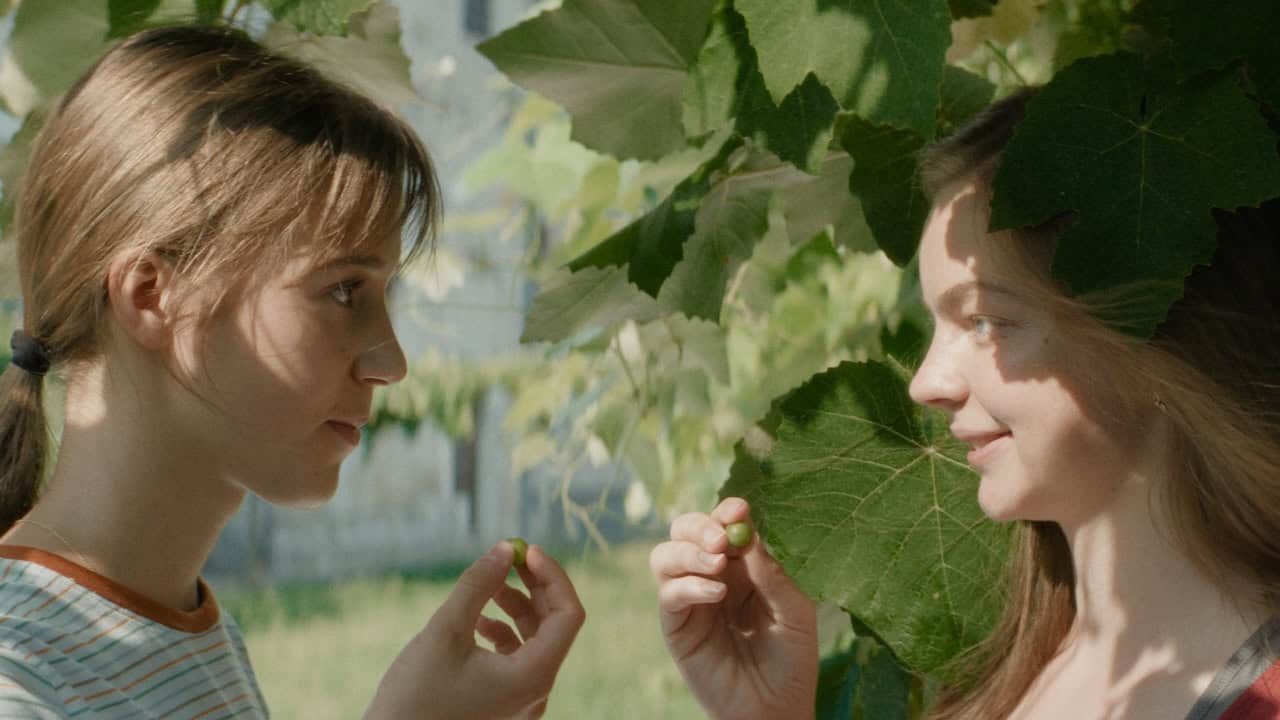
The conflict begins in earnest when Lucia, alongside the rest of the choir, travels to a countryside coven, providing them with a peaceful retreat to practice. On the way there, Lucia witnesses a naked man bathing in a nearby river, which sparks a curiosity within her. During the stay, the choir is forced to practice as construction work is going on, with Lucia, Ana Maria and the others noting the attractiveness of the male workers. These events culminate in a sexual awakening for Lucia, forcing her to confront her religious and sexual views, to the chagrin of Ana Maria, the other choir girls, and the demanding conductor (Saša Tabaković).
Sunny is this picture’s visual canopy, the bright colours of the Italian coven popping off the screen so vividly you can practically feel the environmental warmth. Yet this is in stark contrast to the framing of Lev Predan Kowarski’s cinematography. Although the sun shines and the scenery glows with life, the vast majority of shots are close-ups, many of them extreme. Close-ups of characters’ lips showcase the deceptive difficulty of singing in tune to a mass choir, while simultaneously, from Lucia’s perspective, highlighting the carnal details we begin to notice about people as we mature.
More than anything, these close-ups exist to enforce a sense of entrapment. Lucia is an inquisitive young woman, but this is mired with confusion. Whether due to her Catholic beliefs or her stern upbringing, Lucia has no defined concept of sexuality. Just as she finds herself attracted to one of the coven’s construction workers, she also finds herself thinking a lot about Ana Maria. The only moment of relative peace between Lucia and the conductor is when she confides in him that Ana Maria is in love with her, yet this seems to be a projection based on the available evidence.
No matter where Lucia goes or what she does, she cannot escape the natural change that is happening within. Whether Lucia’s budding preferences ultimately end up being straight, bi, gay, or something else is not the point. Rather, it’s in the ways that finding yourself can be a puzzling, even lonely, process; one that is hampered when religious beliefs teach you to repress or, worse, demonise such feelings.
The tumultuous relationship between religion and sexuality – be it literal or of the coming-of-age variety – has been explored as far back as Brian De Palma’s Carrie. Lucia even has a direct parallel to Carrie White in that she’s a shy 16-year-old who hasn’t yet had her first period. However, instead of resorting to more common routes of trauma or oppression, Djukić’s script and direction encourage curiosity in the face of conformity.
The film isn’t condemning religion per se, but setting this journey of self-discovery against the backdrop of a competitive Catholic choir, where its members have to conform through vocals, pitch, and even fashion, is no coincidence. It serves as chaste but fertile ground for Lucia to explore herself, while also representing the stubborn religious and adolescent constructs that she must break away from. The recurring imagery of flowers – flora that blooms open when ready – serves to highlight the healthiness of change throughout the film. It’s in the theme of rejecting conformity that Little Trouble Girls is at its most astute and emotionally riveting.
Navigating this stellar craftsmanship is a plethora of stunning performances. Ostan is wonderfully subdued throughout the picture, her silence and controlled expressions conveying so much more than outbursts ever could. Small gestures and looks are enough for us to understand the storm brewing inside Lucia’s head and heart, allowing us to empathise with Lucia and her struggles instantly. Švajger captures an organicness to Ana Maria’s demeanour of teenage drama and exclusive antics, while also harbouring deeper layers to her behaviour, as she seems to have long succumbed to beliefs of conformity.
All the while, Tabaković makes for quite the intimidating antagonist as his strict conducting ostracises Lucia and adds palpable weight to the tense atmosphere. In one particularly harrowing scene, the conductor’s demanding antics and inability to recognise Lucia’s emotional strife become so vitriolic that the urge to smack him borders on irresistible. These are compelling characters whom the actors embody with marvellous authenticity.
At times, the slow-burning nature threatens to derail the otherwise absorbing pace. A somewhat abrupt ending may also leave viewers a tad bewildered, its intentions emerging through hefty usage of symbolism. But these cracks do little to undermine the gorgeous photography and confident direction that make up this wonderful picture. Little Trouble Girls treats its weighty themes with the empathy and sincerity they deserve, leaving us with a visually spellbinding and strikingly acted gem of a film. Here’s hoping this is the first of many cinematic delights from the mind of Djukić.
Little Trouble Girls is playing in selected cinemas nationwide now.











Follow Us