
Three Men in a Boat was far from being the box office bomb many have stated, but it did arrive at a time when British cinema was slowly changing, with a new wave on the horizon that would, in part, be led by Harvey, Clayton and the Woolf brothers just three years later in Room at the Top. A brand-new 4K restoration of Three Men in a Boat will be available on Blu-Ray, DVD, and Digital from August 19 on the Studiocanal Vintage Classics label.
From a comedic standpoint, director Ken Annakin’s candy-coloured, loose 1956 adaptation of Jerome K. Jerome’s 1889 novel Three Men in a Boat could be classed as a precursor to the “Carry On” franchise. But stylistically, it also provided the template for the richly coloured, jolly and sunlit Edwardian tales that were to come, from Chitty, Chitty Bang Bang to Those Magnificent Men in Their Flying Machines and Mary Poppins.
Adapted for the screen by Hubert Gregg, the man who brought us “Maybe It’s Because I’m a Londoner” and musicals ranging from The Love Racket (1943) to Strike It Again (1945), Three Men in a Boat carries the atmosphere of a classic MGM musical. Yet, despite its musical tones, which are only enhanced by John Addison’s bouncy, light and optimistic score, nobody in Three Men in a Boat ever bursts into song, aside from a few comedic set pieces. Instead, we are offered a knockabout comedy and Oscar Wilde-inspired farce that strays wildly from Jerome K. Jerome’s original material and characters.
Published in 1889, Jerome’s Three Men in a Boat has always been in print since it first appeared as a serial in Home Chimes, a London magazine published between 1884 and 1894. Originally intended to be a history of the Thames, Jerome’s novel was based on his real-life friendship with two men and their journies together down the Thames at the height of the boating craze of the 1870s. With lashings of beautifully crafted humour and a decidedly darker edge, Jerome’s novel wowed readers, and as cinema came into its own, it was ripe for adaptation.

The 1956 film was to come to life through Hubert Gregg’s radio plays of Jerome’s work, and one avid listener, Jerome’s daughter, Rowena. Ken Annakin, under contract with Rank at the time, was assigned director, and Hubert was to star in the picture and write the screenplay alongside Vernon Harris (Oliver!, Moonraker and The Spy Who Loved Me). However, before filming could start, Rank dropped Annakin, and production was thrown into doubt until Rank offered Annakin the rights to the film, on the condition that he could find a producer and distributor. Enter Jack Clayton (The Innocents) and John and James Woolf (Room at the Top).
John Woolf and his brother James, who had worked for J. Arthur Rank and Columbia, respectively, founded Independent Film Distributors and Romulus Films in the late 1940s, and it was their company that would now distribute and fund Annakin and Gregg’s movie.
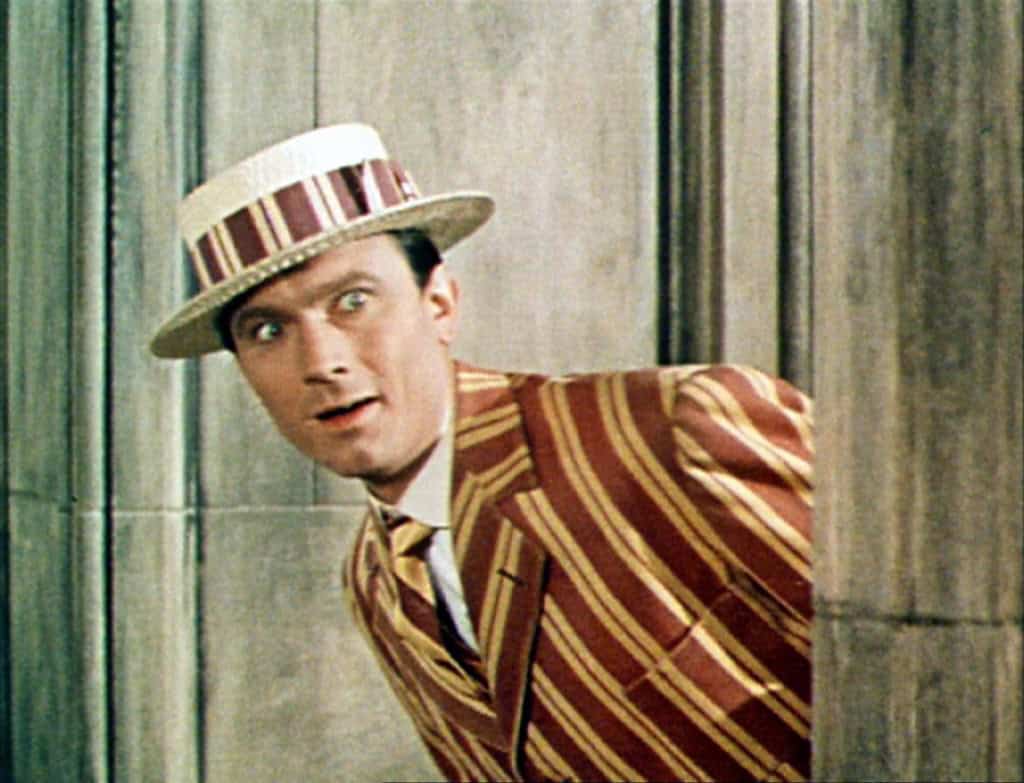
The brother’s involvement immediately led to significant casting changes: out went the original cast, including Gregg, and in came comedy legend Jimmy Edwards, British cinema favourite David Tomlinson, and the fresh-faced, chiselled babe magnet Laurence Harvey, who was allegedly in a relationship with James Woolf at the time. The Woolf brothers even allowed Jimmy Edwards’ writing partners, Frank Muir and Denis Norden, to revise aspects of the screenplay to develop Edwards’ character further. Therefore, by the time Annakin’s colourful movie made it to the screen, it was a very different beast from the movie originally sanctioned by Jerome’s daughter Rowena.
Watching Three Men in a Boat today is like opening a Christmas selection box of colourfully wrapped foil chocolates. Some of the shiny wrapped treats are moreish, but others are sickly sweet and somewhat disappointing. Location work is impressive, as are the performances of Harvey, Edwards and Tomlinson, who truly give the film their all. But the knockabout comedy routines, relentless shouting and garish colours quickly become tiresome, as does the side story of chasing three young women down the Thames in the hope of a romantic entanglement.
Gregg and Annakin’s diversion from the original text ultimately changes the atmosphere of Jerome’s Three Men in a Boat by dramatically altering each character’s path. This leads to a movie that plays so fast and loose with Jerome’s words and storytelling prowess that his genius is missing from the final picture. This flaw in Annakin’s film was later rectified by Tom Stoppard’s 1975 BBC adaptation, directed by Stephen Frears and starring Michael Palin, Tim Curry and Stephen Moore.
However, for all its flaws, Annakin’s movie is a fascinating template for a range of colourful Edwardian-themed movies to come. In many ways, Three Men in a Boat is a perfect Sunday afternoon film; its light, frivolous and engaging performances are full of energy, physicality and joy, even if the comedy runs dry by the final act. Equally fascinating are the themes of male bonding and sexuality that run through the picture.
While all three men may end up chasing three young women down the Thames, two of them, Edwards’ character Harris and Tomlinson’s character J, are unhappy in their current relationships. All three find freedom, solace and happiness in each other’s company; at one point, J even states, when asked if they entertain ladies frequently, “no, no, we don’t do anything with girls. Here, there are themes of latent homosexuality that thread through the physical comedy and farce, which are especially interesting given that two of its stars, Edwards and Harvey, enjoyed the company of men in their private lives.
Three Men in a Boat was far from being the box office bomb many have stated, but it did arrive at a time when British cinema was slowly changing, with a new wave on the horizon that would, in part, be led by Harvey, Clayton and the Woolf brothers just three years later in Room at the Top.











Follow Us