
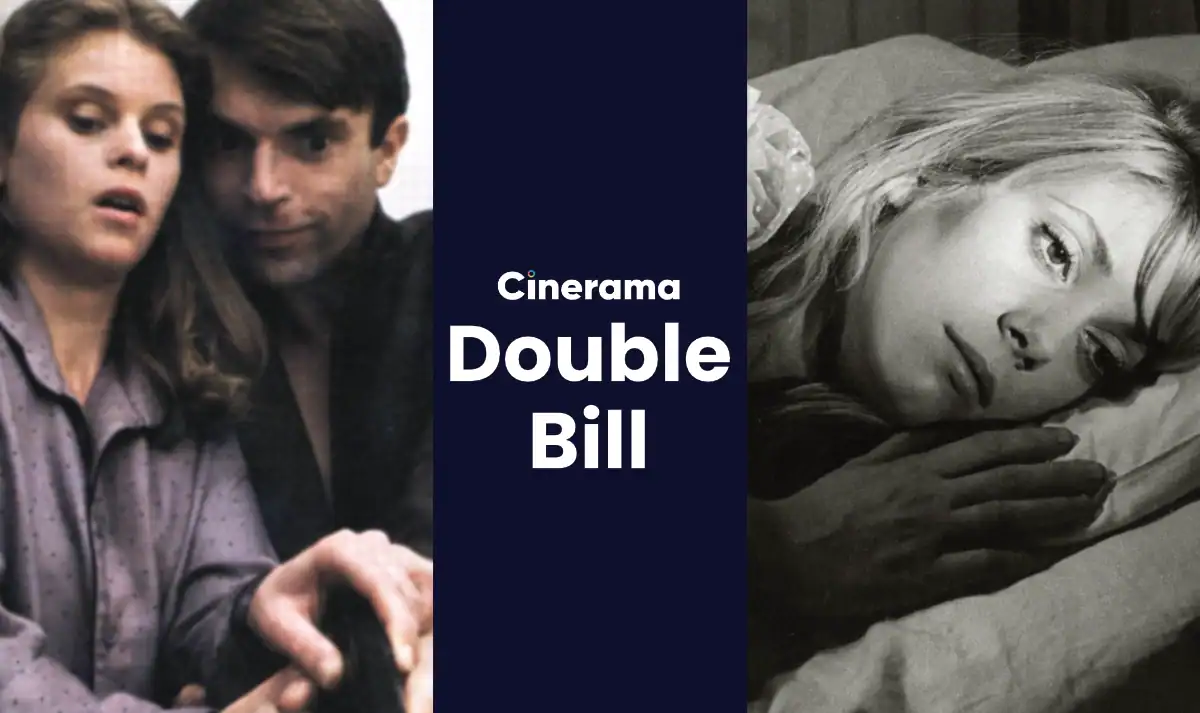
Possession and Repulsion are available to rent, stream or buy.
DOUBLE BILL
POSSESSION (1981)
Polish director Andrzej Żuławski’s only English-language film is a disturbing mixture of divorce drama and visceral body horror. But, if that isn’t enough, the film also has a heavy socio-political subtext, playing with elements of the spy thriller and the doppelgänger motif. Now, I can only imagine how much of a mess this might sound to someone who hasn’t seen it. Yet Possession works brilliantly and remains one of the most chilling, bizarre and deranged horrors to have earned the title of ‘cult classic’.
Mark (Sam Neill) is an international spy who has recently returned to West Berlin to find his wife, Anna (Isabelle Adjani), in the process of filing for divorce. Anna, meanwhile, is being lured into a demonic affair with a tentacled monster in a derelict apartment building on the other side of town. Possession’s genius is held in a multi-layered structure that is visually and psychologically terrifying; it’s gore and surreal horror, a mixture of Cronenberg’s The Brood and Lynch’s Eraserhead.
Meanwhile, audiences interested in relationship drama also get their wish as the film dissects the realities of divorce on a psychological level. Here, the monster reflects Anna’s psychosis while simultaneously providing us with a projection of Mark’s inflamed consciousness. Żuławski wrote his screenplay during an excruciating divorce from his then-wife, Polish actress Malgorzata Braunek. This mix of styles and horror subgenres, in turn, creates a unique movie-going experience, with each audience member taking something different from Possession, with the post-screening drinks at the bar holding a diversity of opinions and thoughts.
Żuławski’s film is an utterly unique cinematic experience, as every aspect works in tandem to create a perfect slice of psychological and surreal horror. But the brilliant performances of its two leads, especially Isabelle Adjani, cement its place as an undeniable classic in every sense of the word.
▽
DOUBLE BILL
REPULSION (1965)

Roman Polanski’s first English-language film is quite possibly one of the most influential psychological horrors of the 1960s. Opening in London, the plot follows Carol (Catherine Deneuve), a manicurist living with her older sister, Helen (Yvonne Furneaux). It is apparent early on that Carol struggles with daily interactions and seems to be repulsed by men to an extreme extent – when her suitor, Colin (John Fraser), tries to kiss her, she immediately brushes her teeth. At the same time, she almost throws up from the odour of a shirt left lying around by her sister’s boyfriend, Michael (Ian Hendry). As Helen and Michael leave for a trip abroad, the story moves to the flat’s confines, where we witness Carol’s slow descent into insanity with haunting precision.
Polanski parallels Carol’s fragmenting mental state with the suffocating, slowly deteriorating interior of the flat, thereby creating the first part of his so-called Apartment trilogy, which also included Rosemary’s Baby (1968) and The Tenant (1976). There is clearly a basis for Carol’s neurological and mental breakdown. Yet, the film does not include a “professional” character (like the psychiatrist at the end of Psycho) to explain or rationalise her psychosis, a key element of similar films of the time.
Repulsion’s atmosphere, set design, and surreal hallucination sequences create a unique and chilling psychological experience. However, the film’s greatest attribute is Catherine Deneuve, an unknown 21-year-old French actress at the film’s release, whose performance elevates Repulsion to become an undoubted masterpiece of 60s horror.
At the time of its release, the film’s choice of topic was remarkable and provocative on so many levels, as it introduced us to a female killer. One who is strikingly beautiful and outwardly innocent, playing with audience perceptions and beliefs. But when you add to this the film’s revolutionary portrait of human sexuality, or rather the repulsion of it, Polanski’s film becomes something new and genre-defining.
As a result, Repulsion would revolutionise the horror genre by taking square aim at the sugarcoated, glamour-enriched style of storytelling that had ruled Hollywood in previous decades. Polanski leaves the conflict at the heart of his narrative for the audience to ponder, deviating from classical storytelling norms while lighting the spark of a new style of filmmaking that would define the 1960s, 1970s and beyond.


















Follow Us