

Black Bear is an enjoyable meta-film that keeps the audience on the edge of their seats by continuously challenging our expectations and bending the genre to what feels like its limits. Black Bear will be available on all major digital platforms starting on 23rd April.
There is always something compelling about meta-films that reflect on their own existence as a work of art. For an audience, watching a film about filmmaking often evokes a feeling that we are in on the secret or getting a peek behind the curtain. Meta-cinema goes against standard narrative conventions by refusing to suspend the audience’s disbelief, deliberately allowing them to remember they are watching a work of fiction. Historical examples go back to the late 1920s with Dziga Vertov’s groundbreaking The Man with the Movie Camera.
Yet meta-cinema is often associated with the self-reflective, arthouse New Wave films of the 1960s, such as Fellini’s 8½ (1963) or Godard’s Le Mépris (1963). The concept remains popular today, with recent examples like Iñárritu’s Birdman (2014) and now Lawrence Michael Levine’s Black Bear (2020), which pushes meta cinema in new and interesting directions by constantly toying with the audience’s perception of what is or isn’t real within the story.
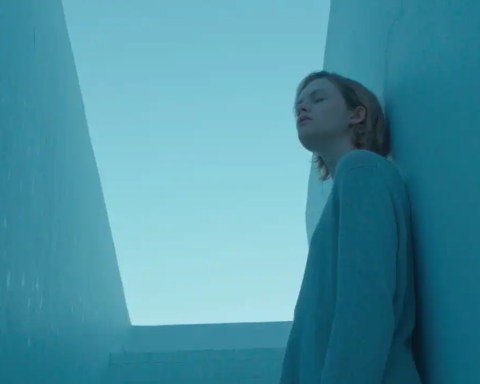
The film consists of two episodes, framed at the beginning and end by Alison (Aubrey Plaza) sitting down to write, indicating that perhaps we are about to see visualisations of the ideas she is working on. The first episode, titled The Bear in the Road, starts as a chamber-piece thriller where Alison, a former actress turned director, stays in a remote lake house to find inspiration for her next film.
Talking through the night with her hosts, a young couple, Gabe (Christopher Abbott) and Blair (Sarah Gadon), the group’s differing outlooks on life soon come to the surface. We learn that Gabe is an unsuccessful musician, while Blair’s drinking habit is compromising her unplanned pregnancy, something they constantly bicker about. Meanwhile, Alison is aloof and sarcastic, seemingly enjoying prodding at Blair. Gabe is attracted to Alison from the start, a fact that is apparent to both women and further fuels the tension between them.
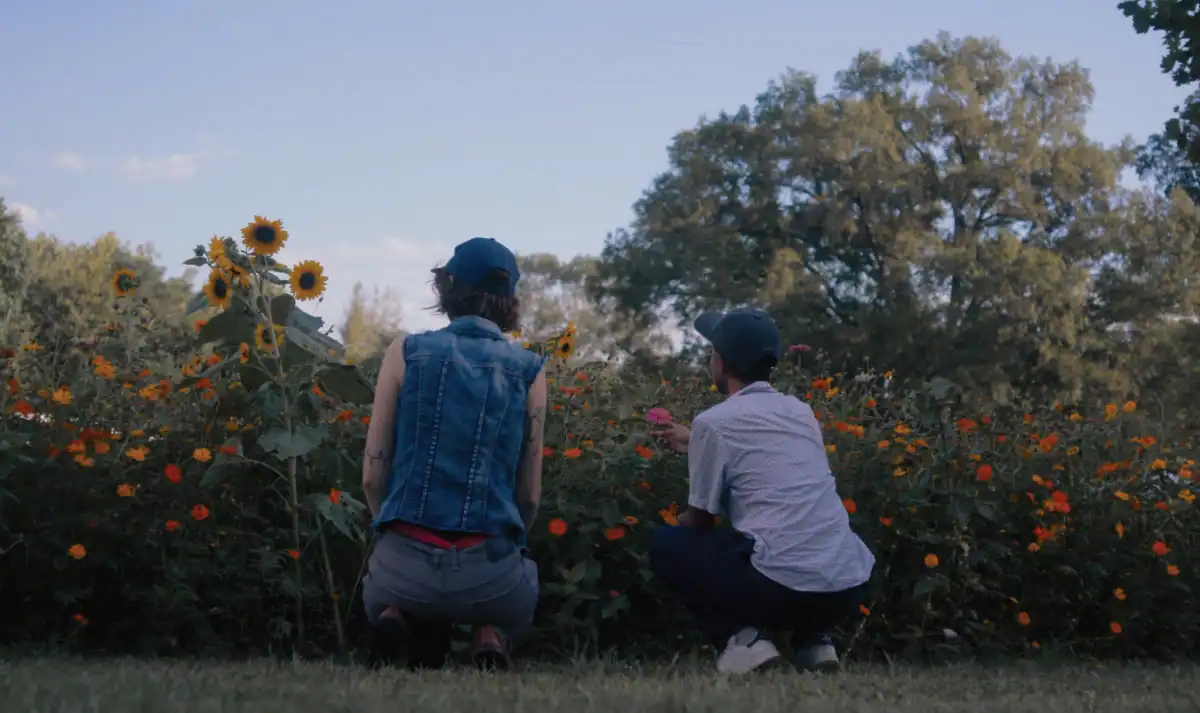
As we question what is happening, the film takes an unprecedented 180-degree turn, and episode two begins. At first, the Bear by the Boat House seems to be giving us the answers we want, only to keep reconfiguring everything we have seen. Here, we learn that Alison is the lead actress in a film being made by her real-life husband, Gabe, and that Blair is in a supporting role. A similarly tense love triangle develops both onscreen and off, only this time, Blair is the interloper and Alison the scorned wife. The film again throws us into the deep end by telling us the same story, but switching up the ingredients and adding another layer.
Throughout the second episode, we watch Gabe pretend to have an affair with Blair to make Alison jealous and to elicit the most realistic and honest performance from the film they are making. Meanwhile, Alison finds solace in alcohol to deal with the situation, showering Gabe with the same insults that the fictional Blair used in episode one.
All these parallels make the audience question what they saw in episode one. Was it Alison’s own version of the events, taking the role she would have rather had? Could it have been a future project of Alison’s where she is trying to process the traumatising events of filming Black Bear, confirmed by her character claiming to be a former actress turned director? Or could it have been a script of hers coming to life in her mind? There are no specific answers to these questions, which leaves the film open to several interpretations and might leave audiences frustrated.
This second part diverts stylistically from the staginess of the first, emphasised by the hand-held camerawork and authentic conversations. However, the film also introduces a screwball element, with the various crew members becoming involved in comical hijinks. These include the script supervisor being so high she doesn’t know which page of the script they are on, and the assistant director frequently running to the toilet due to food poisoning. While entertaining, these moments again draw attention to the artificiality of what we are watching; the making of the film is just as staged as the film itself.
One significant connotation of meta-cinema is that, as the audience sees the crew and director at work, they are also aware of the unseen team in the background. As the movie continued, I expected a finale in which the camera pans out and steps back into reality, showing Levine instructing Aubrey Plaza and the other actors. This did not happen, maybe for the better, because then it would automatically raise the never-ending question of “Now, who is filming this crew?”
The cast is great across the board, but the film clearly belongs to Aubrey Plaza, who remains the most likeable character in both episodes, despite playing the temptress in the first and the scorned woman in the second. Her performance in the film’s opening episode clearly plays off Plaza’s established persona as a dry-witted and ever-sarcastic comedienne. Yet, in the latter half, she hits notes that we haven’t seen from her before.
The second episode clearly borrows from John Cassavetes’ masterpiece Opening Night (1977), which is also about a drunken actress undergoing an emotional crisis, with those around her insisting she press ahead with the performance. All of Black Bear’s toying with metatextuality does have a purpose; like Opening Night, it raises thought-provoking questions about the sacrifices we make in the name of art. Is it worth forcing an actress to suffer a mental breakdown to achieve a great performance?
Given all the stories over the years about how great directors like Kubrick and Hitchcock have treated their leading ladies, as well as more recent revelations about the likes of Joss Whedon, the question of how artist/muse relationships can easily slide into abusive territory has long remained a pertinent one.
Black Bear is an enjoyable meta-film that keeps the audience on the edge of their seats by continuously challenging our expectations and bending the genre to what feels like its limits. The film is dialogue-heavy and sometimes feels a bit too ambitious for its own good, but the core emotion is enough to keep you hooked until the end.
The lack of answers and assistance in understanding what is going on is one of the film’s most frustrating elements and most considerable charms. The best example is the titular black bear, which shows up after both episodes to bring things to a potentially violent end. It’s abundantly clear that the bear is not just a bear but a symbol of something. Here, the film actively provokes the audience to figure out what. One explanation is that it symbolises a creative crisis in which the off-screen writer is simply running out of ideas. It’s as if Levine was saying: “I have no idea how to finish the film. You come up with it yourselves,” and surprisingly, it works.











Follow Us