

By portraying a Chinese nuclear family shattered after 14 years of migration, Montreal, My Beautiful, not only challenges the constraints imposed on sexual self-realisation but also gestures towards a broader disillusionment experienced by first-generation immigrants navigating the demands of assimilation.
Chinese-American multi-hyphenate Joan Chen returns to the big screen, ushering in a new chapter with her challenging yet daring role as Feng Xia in Montreal, My Beautiful, a female-led drama centred on a late-life sexual awakening triggered by an encounter with a young, charismatic Montreal woman named Camille.
This bold and adventurous story is written and directed by He Xiaodan, a Chinese-Canadian filmmaker who migrated to Montreal at the age of fifteen. Her interest in migrant family narratives within a transnational context is already evident in her previous work, A Touch of Spring, which similarly unfolds from a marital rupture between a Chinese couple living in Montreal.
Montreal, My Beautiful opens with Feng Xia (Joan Chen), a married woman in her mid-50s, who becomes increasingly aware of the undeniable changes in her body and a growing fatigue within a relationship marked by stagnation and quiet erosion. Her husband, Wang Jun (John Xu), is a small-minded, domineering man, reluctant to let go of his past job — a typically patriarchal figure who maintains a rigid hold over the family. Together, they run a local shop and raise an older daughter and a younger son.
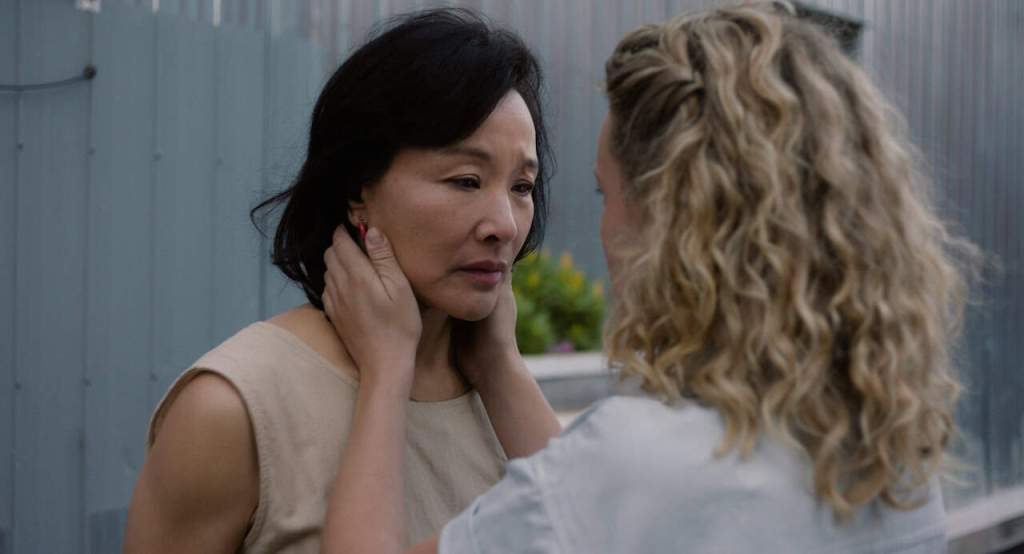
Feng Xia’s trajectory begins to shift when she discovers that dating apps offer a discreet channel for connection. Years of repression and deferred desire start to fracture when she receives messages from Camille (Charlotte Aubin), a lost young woman working at an upscale restaurant. Summoning her courage, Feng Xia agrees to meet her in person. Initially unsettled by Camille’s directness, she gradually finds herself drawn into an unfamiliar intimacy. As their encounters deepen, Feng Xia begins to explore her sexuality, confronting impulses long kept dormant, as if undergoing a process of rebirth (in Chinese, the name “Feng Xia” suggests “phoenix in rising sun”).
However, her increasingly precarious behaviour does not go unnoticed. Wang grows suspicious, follows her, and eventually discovers her involvement with another woman. His reaction is immediate and volatile, precipitating the collapse of their already fragile relationship and casting uncertainty over the family’s future. Even after the truth is exposed, Feng Xia attempts to preserve a semblance of familial dignity, urging Wang not to disclose the situation to their children.
Her plea reflects the enduring logic of “saving face,” a deeply ingrained cultural mechanism within many Chinese families. Despite the near-total depletion of intimacy between them — exemplified by Wang’s cruel remark during sex, dismissing her as a “dead fish” — they resist the prospect of divorce, constrained by social expectation and external judgement. Director, He situates this familiar dynamic within a diasporic framework, drawing attention to the persistence of inherited values within migrant contexts.
While the film can be read as a story of forbidden desire emerging from a heteronormative structure, He is not confined to audacious moments of sensuality. The tension between Wang’s conservatism and Feng Xia’s transgression is palpable, yet the film also traces a quieter dissonance between Feng Xia and Camille. Camille inhabits her identity with relative ease, whereas Feng Xia remains suspended between longing and restraint, ultimately unable to commit fully, tethered to her role within the family unit.
Although Chen has taken on daring roles before, this marks her first portrayal in an explicitly intimate lesbian narrative with such physical and psychological exposure. It faintly echoes Saving Face (2002), where she played a mother grappling with her daughter’s sexuality.
Here, however, Chen extends her range, navigating Feng Xia through layers of ethical tension and finely calibrated restraint. Her command of gesture, stillness, and minute facial shifts renders the character deeply convincing, shedding the familiarity of her star persona. Once again, Joan Chen demonstrates a remarkable screen presence, bringing an unexpected charge and nuance to the role.
Opposite her, Charlotte Aubin matches this intensity with a performance that balances openness and vulnerability. She conveys both the urgency of desire and the lingering fracture of abandonment, particularly in relation to her absent mother, whose departure continues to shape her sense of self.
It is somewhat regrettable that the film engages only superficially with Montreal as a spatial and cultural environment, missing an opportunity to embed the characters more fully within the city’s textures. While the relationship between Feng Xia and Camille is carefully developed, the narrative treatment of Wang and the children remains comparatively thin, functioning more as structural supports than fully realised figures. This imbalance culminates in a final turn that feels somewhat imposed, lacking the organic progression established earlier and slightly disrupting the film’s overall rhythm.
By portraying a Chinese nuclear family shattered after 14 years of migration, Montreal, My Beautiful, not only challenges the constraints imposed on sexual self-realisation but also gestures towards a broader disillusionment experienced by first-generation immigrants navigating the demands of assimilation. Within this tension, the question of whether to remain or depart becomes a persistent, unresolved force. Ironically, the imagined possibility of a freer future — of loving without inhibition — gives way to a more grounded reality, quietly anchored in the understated beauty of Montreal.













Follow Us